A Comment that wasn’t – because too long!

What follows is a much-too-long comment in response to a throwaway remark on The Moon of Alabama’s comment thread.
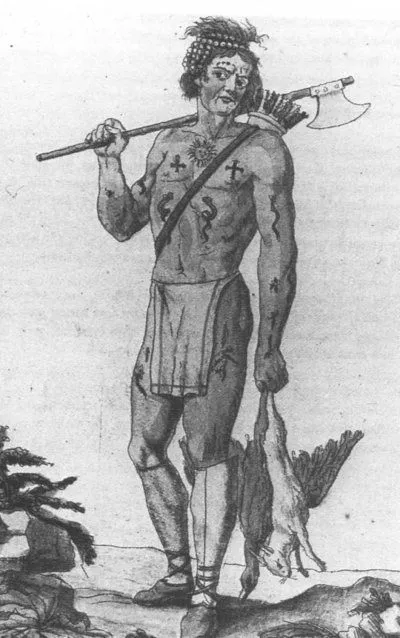
Cape Breton Mi’maq Indian, source unknown

The Portuguese in the Asia pacific – they were there quite early.

Posted by: Peter AU1 | Apr 18 2023 8:02 utc | 148

Our histories are all garbled deceptive rubbish. (You would use more salty terms, Peter AU1!) Take the Portuguese for example: I used to have a little 24 foot sloop anchored in Gabarus Bay, Cape Breton. It was named such by Portuguese who were there since the 1300’s. Near La Rochelle France there is a strait called Breton.

It is a portolan* port with the Breton Strait so named because by following its latitude you come to Cape Breton, Nova Scotia, and that connection was made long before 1492. For example native Mi’kmaq historians in Cape Breton tell of a treaty made with an English king in the 1100s. They sent several hundred of their strongest warriors over to fight in one of the great battles, Crecy or Agincourt. To this day many of the men have huge arms and shoulders and are very intimidating to meet in gas stations where for some reasons many congregate! This is because their ancestors made and used very large bows operated by lying on the ground and arcing them with both legs before release – probably for bringing down mastodons, saber-tooth tigers, maybe even tyrannosaurus rex … who knows!. Their arrows were so much more powerful than anything the English or French had that they were armour-piercing. At that time, the French had the technological edge in the form of excellent armor for their mounted knights who were almost indestructible. They could be hacked away at for hours without anyone being able to bring them down.

[* The portolan wikipedia link doesn’t do a good job describing them, but it’s all I could find on short notice.]

I can just see it: some pimply, poncy Duc de Cologne or Marquis de Brie, rises to partake of camembert, garlic and wine of a morning, along with his petit pain and je ne sais quoi, then dons his outfit and, quaffing the familiar reek of all that national culture swirling around in his helmet, he surveys the enemy laid out in battle formation before him. Through the garlicky haze he spots an unfamiliar, well nigh unbelievable, sight: a couple hundred half naked enormous* savages with feathered headresses lying down suddenly. No doubt they were terrified of our superior French armour, he thinks – or perhaps they were intimidated by the odours of cheese and garlic, of our superior French cuisine? Hard to say, but in any case clearly these godless heathen savages have been awed into instant submission. As all should be in the face of their great King and the Mighty French!!!

But just as they are chuckling in arrogant glee as they keep finding ways to smuggle ever more cheese and wine through their bulky metal visors (whilst their wives wait at home with bulky metal padlocks around different, lower-situated mouths!), a command goes up from the opposing side, all the naked savages start moving mysteriously and then suddenly a dark, bristling hail of arrows comes flying in unison through the air issuing forth from this body of bizarrely prone half-naked savages. The arrows come fast and thick and before they even have time to wipe away their grins, many of France’s bravest knights and wealthiest Comtes and Marquises lie dead from thick wooden arrows that easily pierced their otherwise unpiercable armour leaving only a lingering odour of garlic to remember them by. There are scattered records including drawings in the English history books about the Mi’kmaq Chief and his daughters. He was best friends with the English king, apparently, and they got along famously. This is all back in the 1100’s. The tribe’s history goes back long before the ice age, they say. And some of them became Christian. [See below attached history book: Basket Stories by John Bear MacNeil.]

*[ in those days Europeans were nearly all quite small, around 5′ tall if you go by their armour. The Mi’maqs were around six feet and built like NFL linebackers, almost giants. Those Frenchies never knew what hit ’em; and Shakespeare wasn’t tellin’ when he dramatized the battles centuries later…]

So the whole Columbus discovery story is just another set of lies. He had Piri Reis maps most likely and if so knew the coastline pretty well from them. (Those maps show Antarctica accurate to within 100 meters, something only satellite surveillance can match. We have no idea who made those maps or how.) Admiral He’s greatly reduced fleet of ‘only a few hundred’ at that point was in the Caribbean around 1421-2 and then went up to Cape Breton where they built a structure whose remains are still there to this day. The Chinese left artifacts all over the Gulf area in Texas and elsewhere, carved dragons and such like I believe. And of course the Vikings were coming to the Americas long before Columbus as well.

I spent precious time with a Mi’kmaq chief a few years back who told me that according to their tribal histories, Asian people in China are actually their descendants, not the other way around, but this was a very long time ago. She – for they are a matriarchal tribe – was insistent on this point. Now these are Northern peoples who learned to live in a world of ice and snow. The world at the top is a small circle and it’s only a matter of a week or so’s hiking that determines whether when you go South you end up in China, or America, or Norway, or the vast middle in Russia. So I think she was talking of the northern peoples who lived through the ice age in the ice or thereabouts. She says they originally come from around Manitoba long, long ago. Some call them Eskimos. Some call them People of the Deer and there are entire provinces in Russia with millions of these fully autonomous people to this day – far happier than their decimated, impoverished relatives in Colonial Canada.

But there are no doubt many strains of those who have peopled Asia who came from tropical region oceans, not only those from the ice-bound North. Some of them may have come from great lands existing before the scattering of small islands now left today, perhaps the lost civilization that built those huge men staring into space. Such things are simply not known in these latter days. But as the polygamously constructed Warram catamarans ably demonstrate, you can sail the world very nicely in twin-hulled dugouts lashed together intelligently – no need for floating papyrus reed rafts with sails, though they can do the job as well if far more clumsily. People have been navigating by the stars in the Pacific since time out of mind. We have no way of knowing how far back such things go.

And all along there have been battles between builders and plunderers. This is not really a racial thing as too many attest, including here on MoA. Racism is usually riled up to justify violence the purpose of which is to steal other peoples’ stuff. It’s realy a plunder mentality thing, something karlof has studied extensively. Some peoples build and other peoples raid and take or capture and enslave. Or more simply put: some people give and other people take. A friend of mine was chatting with a Chinese martial arts master decades ago asking him about the origins of the many different fighting forms they have like Tai Chi, kung fu etc. The master told him to check with our Tibetan Buddhist master for, he said, it was Tibetan monks who developed the organized fighting forms later taken up by the Chinese. (I’m not sure if this is correct given some of Hua To’s medical qigong animal forms from the time of Christ but…) There were so many bandits and robbers in organized gangs roaming all around everywhere stealing, raping, pillaging etc. that the monks developed ways of defending themselves using their advanced yogic skills to craft fighting methods involving the harnessing of prana-chi which they were already doing for other purposes. The story is more than plausible, but the point is: there was plenty of plundering going on in Asia just as everywhere else in the world. And of course Africa was rife with it, not to mention the world’s greatest supplier of slaves.

Russia-China is proposing a new civilization for builders and peacemakers. All decent people should wish them well. But whatever they build will become a target for plunderers. Such mentalities will never go away even if there is not a single white person living anywhere. For plundering has nothing to do with race. It’s a Cain and Abel thing, yin and yang, moon and sun, night and day. Some things never change.

(Also posted at https://ashleyschowes.substack.com/p/a-moon-of-alabama-comment-that-wasnt )

An unconventional history of Cape Breton Island:
Yi: Should we fire the Mason now? 60 > — < 27


Gua Hexagram #60

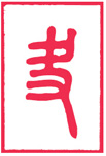
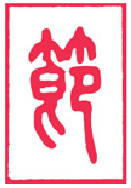
The ideograph attempts to express the original meaning of Jie, to set bounds. At the top there are two sets of lance-shaped bamboo leaves. Below the leaves is the character ji, providing the sound. Ji means immediately or instantly; it sets a time restriction. The left side of ji depicts a seed of grain with a tiny sprout at the top and two tiny roots at the bottom. On the right is a sickle. These two images suggest a picture of cutting grain and eating it immediately.

Originally the right hand image represented an ancient verifying token made of bamboo. When a piece of bamboo has been split in two, each half becomes a verifying token. If the two pieces match each other, then each person who has one holds a trustworthy credential. Tokens made of bamboo slips were commonly used by ancient governments to verify the identity of an individual.


I include this not to turn the blog into some sort of diary but as an example of using the Yi in everyday decision-making. Truth be told I don’t tend to use it for mundane, particular issues such as this so this cast was done mainly as an opportunity to examine whatever hexagrams thrown up in a different type of context than the broader, generalist geopolitical-philosophical which this blog and the substack have of late been exploring. In so doing various associations with the hexagrams in question are stretched or reexamined. Interestingly, #60 turned up just yesterday regarding Core Principles for Good society these days (as opposed to in ancient China or some such). Also #27 has arisen in three throws in a row first as derived, and now twice as Nuclear.

Which is interesting too, because one might not see how a hexagram one day describing how to create a good society – seeing as we are now participants in a New geopolitical world order being formed – is now arising the very next day about how to deal with a tricky, though not exceptional, personal situation. But the answer yesterday about Core Principles emphasized sincerity, setting limits, establishing good discipline whilst all along cultivating virtue and good health (#27) in family life – hmm, that’s a better summary than I published yesterday … understanding improves after marinating a little while.

But all those principles, excellent as they are for society as a whole, are also helpful on the individual level and indeed that is partly what yesterday’s Reading intimated in that paying attention to the small, to what is essential inside, not flying too high, setting limits etc., that is what works because that is what engenders virtue; and the development of virtue in society is a direct result of the collective development of virtue by each and every individual within it, each of whom is part of and thus helps determine the nature of the whole. As above so below and vice versa.

In the same way that the Yi can serve as a lens into the future by acting as a magnifying glass mirror into the deeper aspects of what is now transpiring in the present, so also we can understand broader society by the nature and actions of the particular individuals within it. The universe is holographic, so we should not be surprised that we can peer into the same hexagram to catch glimpses of the universal even as we are using it to examine any given particular. The Yi, in other words, is just like ordinary life; which is what we would expect in any source of time-tested wisdom.

Yi: Core Principles of Good Society Today 61-6 > 60 < 27

61 Profound Sincerity > 60 Discipline < 27 Nourishing Virtue Query in relation to MoA Comment

Gua Hexagram 61 Innermost Sincerity

The name of the gua is made up of two Chinese characters. The ideograph of the first character, zhong, is a picture of an arrow that hits the center and passes through a target. The rectangle represents the target and the vertical stroke, the arrow. Only an arrow passing through the target in the center can strike a balance, without pushing the target to the left or right. The second character, fu, is a picture of a hen hatching her little ones. At the top of the ideograph is a hen’s claw, representing a hen. The lower part is a picture of a little one with arms stretching upward. An image of a hen hatching a chick was created to express sincerity and trustworthiness. In hatching chicks, the hen must be faithful to her obligation.


From the comment:

The specter of “Evil Communism” lives on in your mind like an evicted tenant in a shanty squatting not paying rent.

Posted by: Tom_Q_Collins | Apr 16 2023 5:52 utc | 120

“Part of the problem is that ‘communism’ was wrapped up in a bankster-led worldwide conspiracy to take over everything. So there was quite a gap between the theory and what actually happened. Another problem is that pretty much by definition communism involves excessive centralization which is the most efficient way of governing but also highly prone to corrupt capture, the prize dangled before their gaze so tantalizing as to engender multi-generational organizations to effect such capture, organizations which over time develop far greater depth and skill than the official organs in place by whatever system, in this case ‘communism’ which is in many ways easier to capture than more messy ‘democratic’ systems. That said, they are all capturable. And once captured, the terrain becomes extremely confusing both to see and to discuss because of course one of the sine qua non techniques of such capture is deception both in word and deed. Gradually everything becomes both opaque and confusing.

When all is said and done, all systems depend upon mutual good will between rulers and ruled, government and people. If too much evil intent enters the mix, it is very hard to spot, contain, reveal or expel. This is why how a society is structured culturally is as important as how it is structured systemically/administratively. This is where old methods like royalty, church, aristocracy came in. Having been largely expunged in most modern polities, they don’t come in much any more. So the challenge Russia and China (and others) are meeting these days is how to fashion societies where good will is a bedrock value permeating all levels of their society without those old institutions which seem no longer suitable for the much larger populations we enjoy today.

In Chinese philosophical terms, everything boils down to Heaven, Earth and Man, an experience-based trinity principle far older than the one proposed in the New Testament but essentially similar. Heaven is the over-arching context, Earth is the terrain complementing it, the relative elements we navigate through under the sky of Heaven, and Man is the navigation process, how good or bad a job we do, what sort of individual and collective world we make in the process of making our way through the journey of life. In a successful, good society, the Heaven aspect includes some sort of basic reverence for the fundamental goodness of life, including all creatures and terrains where life manifests, both visible and invisible. If the society as a whole generally enjoys a shared sense of such reverence, or respect if you prefer, than all the human elements in that society will generally row in the same direction, which will foster goodness and good life journeys for all involved.”


Additional Remarks

The Yi Cast offered up surprisingly apropos hexagrams in response very much along the lines of what I had expressed in the Comment, some of which of course comes from having studied the Yi approach for decades now. That said, although learning to navigate through the fathomlessly intricate hexagrams, trigrams, shamanic and confucian commentary and underlying theory may be a tad difficult – and indeed I regard myself as little more than an advanced beginner at this stage especially given that only of late have I started to study it more seriously – the underlying principles are simple enough that most children can readily understand them, including Heaven Earth and Man. The old Chinese – and most inter-related Asian societies – incorporated such things into their gene structure, basically, so even modern Chinese who may never have studied such things – as I learned years ago on some English-speaking Chinese forums – still understand them well for they are part of how they perceive reality. Just as most Westerners (and indeed most modern people nowadays including in Asia) have incorporated the materialist view so much so that they are entirely unaware not only that they hold it, but also that it is both optional as well as profoundly flawed.

The latter, although it can facilitate truly ghastly outcomes, is not a big deal. Human beings exist not only between Heaven and Earth, but also heaven and hell, and our life journey involves cultivating the good and eschewing the bad (Hexagram 27, Mouth-Nourishment-Cultivation). One way of doing this is holding to the Middle which is both a Confucian and a Buddhist approach. Indeed, the Buddha called his approach ‘The Middle Way’ not Buddhism. The middle avoids extremes. Hexagram 27 ䷚ with solid lines and top and bottom kind of indicates this. Life – the four yin lines – takes place in the middle where we avoid extremes of Heaven and Hell. Indeed, the Nuclear of 27 is #2 with all six lines being Yin. This represents Earth, the Mother, Mother Nature, material and relative reality. It is why the little poem I composed after the Judgment in the document above begins with over-arching Idea and ends with enjoying a good meal at the family kitchen table. Such basic, ordinary pleasures are what high civilizations cherish and promote. A little like Tolkein’s Shire, perhaps, with humble hobbits being those who save the world more than all the Wise and Great were able to do. Civilizations without humility and true inner sincerity founder. Always. Every time. The West is now foundering, as it should. The people will have to find a way back to ordinary common sense and basic decency. Asia-Eurasia is rising, after a difficult couple of centuries. As they rise and their growth slows, they too will have to deal with increasing corruption which always starts to infiltrate and spread, and they too will need to ensure that their people, their society, is rooted in bedrock virtues and values lest they too, like the West, go astray.

Which is a roundabout way of explaining why being mired in the mud of materialist fallacy is not the end of the world. Because if it isn’t materialist mud it’s something else – religious fanaticism, political extremism, banditry, sexual excess, demonic possession, chronic misery and wretchedness, blood sacrifice cults… whatever. Always something extreme pulling us towards excess of pleasure or excess of pain, aka heaven or hell.

In any case, the West was never as perfect as many of its cheerleaders like to portray. But it wasn’t all bad either. You just have to walk into one of the great cathedrals to appreciate this instantly. At the same time, if you sit quietly, you can feel that most of the gods who used to muster there are now absent; there is a dark, slightly haunted feeling along with evident beauty, majesty and depth. They are a little sad, their nearby graveyards a tad too gloomy. The vivid brightness of the Renaissance during which many latter-day churches were built, filled with light, seems more like a memory than a lived reality.

In our experience, the present moment is always vivid and fresh. When everyone is working hard and things are going forward day by day it is not hard to feel energy and momentum and for all to pull in the same direction – even the thieves prosper in such times after all! But once things have stabilized and the momentum period is over, then it’s not so easy. Many individuals in their forties start to experience the chickens of their youth coming home to roost in middle age, and it doesn’t always make for happy family dynamics! Then in maturity and old age we experience the harvest of our earlier years, the degree to which we followed bedrock virtues and values, and the degree to which we strayed.

Civilizations ultimately are not about Empire building, conquest, wars and subjugation. They are about creating good containers for good human life journeys. Such things require an appreciation for the small, the ordinary. Hexagram 61 is about inner truth or sincerity. Hexagram 62, the last process hexagram before the final Completion pair 63 & 64, is about ‘the preponderance of the small’ four yin lines surrounding two yang lines, the graphic opposite of 61 (and why they are paired together). This is where the commentary describes how the flying bird (the body represented by the two central yang lines, the wings being the twin pairs of yin lines above and below) always has to come down to Earth at the end, no matter how high it has flown. Towers built by Sauron always fall in the end.

In the Buddhist and other yogic lineages, masters of meditation go through years of training and extraordinary experiences, plumbing the depths, soaring to heights in endless inner worlds that all of us contain within. Some develop seemingly magical powers, can cure all illness, read others’ minds, learn things in lucid dreams beyond normal ken, influence future rebirths and so forth. But in the end they come back to what the Tibetan Kagyü tradition called thamel gyi shepa, translated as ‘ordinary mind.’ Ordinariness is the highest attainment, experience without extras, add-ons, embellishments, enhancements, ideologies, propaganda, regulations, restrictions, aspirations, second thoughts – even first thoughts. Just direct, ordinary ever-present awareness. High cultures engender this so that we don’t all have to live in caves for decades to achieve this most ordinary of qualities. Cultures which throw up sane and beautiful architecture, delicious and healthy cuisine, artful and practical forms of dress and speech, all grounded in awareness of things as they are, not things as we might imagine, desire or demand them to be, things which ideologues promise (and never deliver) and tyrants or totalitarian regimes mandate. Cultures that do not engender bedrock virtues are not high, no matter how much they believe and proclaim otherwise.

Man lives between Heaven and Earth in what is basically a primordially good setup. All we have to do is work hard at keeping it simple, keeping it real. That’s the upper trigram Water in #60’s Discipline / Limits. Water is the trigram of Work, of flowing around but also gradually wearing down obstacles, creating rivers running through canyons; water finds its own level, its destiny; and water is essential to life, to blood, to movement. Work takes as long as it takes; and for Man, as Adam was informed, work is continuous and ever-present, is a life long 24/7 affair.

In this Cast, the heady speech of lofty goals in the top line turns us to Discipline #60, the one that came before #61. So any time we start to get excited by ideas, we return to bedrock discipline, to the basic work of the Middle Ordinary Way which, interestingly, is based on Lake Below, the youngest daughter, the pleasure and joy principle. Life is not fundamentally drab and drear. It is fundamentally beautiful. But this has to be tempered with Wind and Water, with patient Gentleness and steady, smooth flowing Work.

And so it goes….

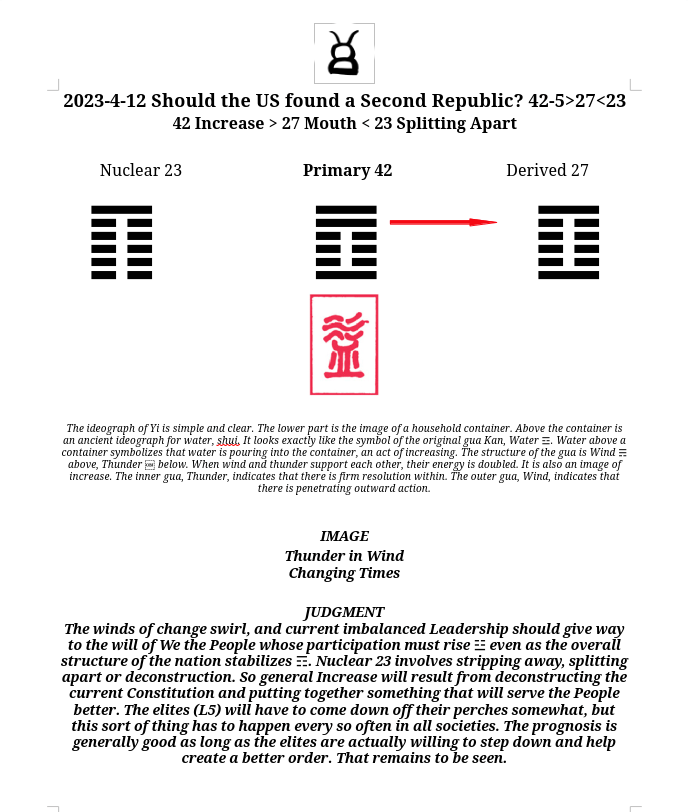
Yi: Should the US found a Second Republic? 42-5>27<23


Another in this political-geopolitical series, and another loaded question which of course is implying that maybe it’s time for American citizens to ditch the old Republic and put together a new one – like is apparently the French can do much more easily, though whether it has proven helpful is probably debatable.

In any case, the pdf for download below contains the answer!

Yi: What makes for a meaningful life? 9-1,6 > 48 < 38

9 Power of the Meek > 48 The Well/Source < 38 Differences

Hexagram #9

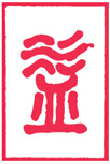
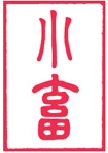
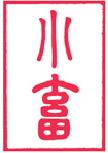
Hexagram #9, The Power of Humility: there are two ideographs that demonstrate the meaning of this gua. The first ideograph denotes “little.” It is made up of three strokes, one to the left and one to the right, with the third vertical stroke going all the way from top to bottom between the left and right strokes. This character symbolizes an act of dividing. To the ancient sages, things become little after division.

The second ideograph consists of two parts. The lower one represents a field, and the upper part represents two piles of grass stored one upon the other with a cover on the top. The whole ideograph is a picture of storing up or accumulating. [Huang]

On 4/6 I enquired about RFK as a Presidential Candidate in upcoming US Federal elections. On 4/8 I enquired about President Xi’s geopolitical intentions, essentially asking whether or not he was a good, well-intentioned world leader type or not. On 4/11 I enquired ‘what makes for a meaningful life?’

All three throws responded by offering up Hexagram #9 which Wilhelm translates as ‘The Taming Power of the Small.’ What is meant by ‘taming power’ is that the single yin line is the master of the other five yang lines. Since yang is usually regarded as dominant to yin’s submissive, this is a reversal of sorts, hence the notion of ‘taming.’ The single yin tames the five yangs, which together represent a situation involving great power or great potential. Only Hexagram #1, with all six lines being yang, is more powerful this way.

Now Hexagram #9 is one of six hexagrams with five yang lines and one yin line. Starting with the single yin at the bottom they are:

#44 – Coming to Meet or Intercourse

#13 – Fellowship with Men

#10 – Treading (on the tail of the tiger!)

#9 – Power of the Meek

#14 – Possession in Great Measure

#43 – Breakthrough, Proclamation

Note that 9 & 10 are paired, as are 14 & 14 and 43 & 44. The first three have Heaven Above and something else below depending upon where the single yin line below is, and the last three have Heaven Below and something else depending on where the single yin line above is.

Hexagram #9 has the yin line in the fourth place which is typically described – in political-hierarchical terms – as the line of the Minister (who serves the Ruler in the 5th place as opposed to the Sage – above all such things – in the sixth place). So not only do we have one yin line controlling five yang lines, but also this particular one in #9 is in the subordinate Line 4 position. So this position emphasizes the humility aspect of yin controlling or ruling yang.

There is no such material thing as yin or yang. They are abstract comparative terms, or polarities if you prefer. The warm sun-facing side of a mountain is yang, and the cooler side in shadow is yin. This makes immediate experiential sense but is a constantly changing variable as the sun moves across the sky from dawn until dusk. Hence the Book of Changes (I Ching): everything is always changing and yet there are recognizable patterns or situations, such as the mountain example above.

There are also three main levels of experiential reality assumed in the I Ching world view that are not often mentioned because they are so fundamental. (I also suspect various masters of yore deliberately didn’t want to spell everything out to obviously.) These three are called Heaven, Earth and Man about which more upcoming, hopefully.

In a hexagram, the top two lines are Heaven, the bottom two lines are Earth and the middle two lines are Man. According to some texts cited later on in most editions, the reason for having six-line hexagrams instead of simple three-line trigrams is to give Heaven Earth and Man two lines each. In any case, both individual trigrams and hexagrams have a Heaven Earth and Man structure that is instantly apparent to anyone brought up in this worldview. Let’s look at the three different levels, or aspects, briefly:

Heaven sets the overall mood or context, like the sky in a landscape.

Earth complements that overall mood or context, like the terrain in a landscape.

For example, when you have a bright sunny day with only a few puffy white clouds, the landscape below – trees, fields, cattle, small town on a hillside in the distance, all complement the initial tone set by the sky. But if the sky is dark, brooding, menacing, or even spewing down heavy rain, then the Earth complementing it will also look and feel different from how it did before; it will have darkers shadows, more gloomy areas, the town will look less cheerful and so forth.

Then comes MAN. All three aspects are experiential, but Man is the most dynamic in that it specifically references human agency. You have the sky, you have the terrain (in our example) then you have how it is all put together. For example, the MAN principle involves how the fields are shaped and tended for; how many and well looked after are the cattle; the architectural style and taste of the small town – does it have nice church spires or domes or is it a huddled mass of lowly cattle sheds with a communal field for defecation etc.?

The sky, terrain, man example above is easy to understand, but it’s just an example. You can learn to pick up on these three aspects, or principles, in all experiences, both inner and outer. In terms of our selves, for example, we have mind (heaven), body (earth) and feelings/processes/experiences (Man). Or morally we could say that we have a sense of what is ideal (Heaven), a plethora of situations that happen to us – our family, our town, our society, various events etc. – (Earth) and how we handle them (Man) – do we become a better and wiser person over time or do we become a lowlife, evil-doing demon?

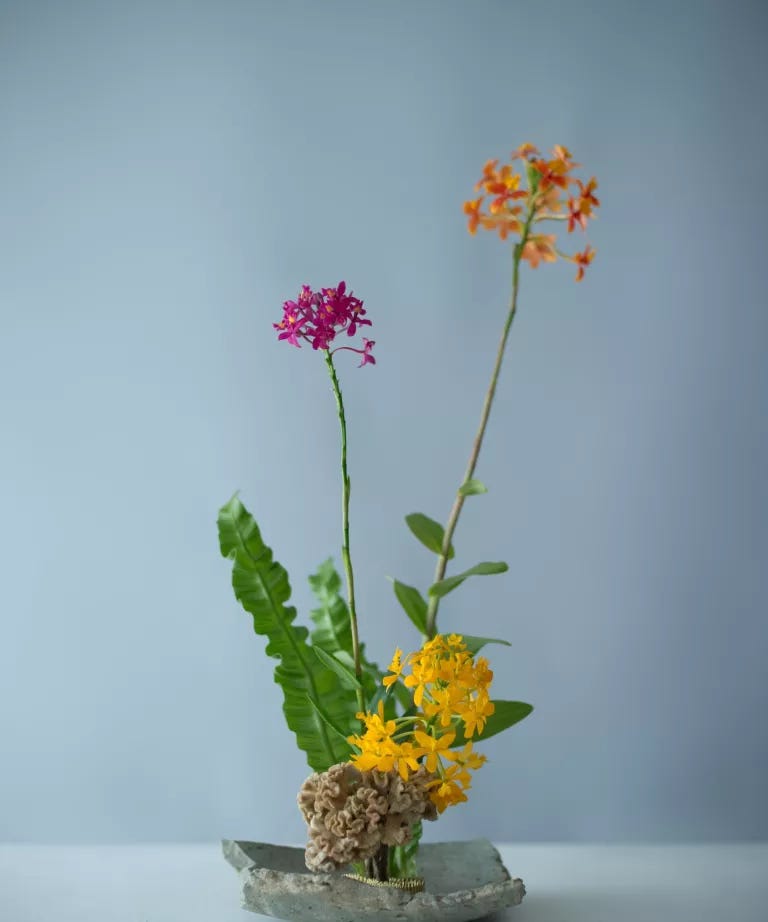
Some people see them in artistic disciplines, such as flower arranging. The first branch or flower placed is Heaven. Then something lower down complements it. Then finally Man is placed bringing the whole thing into some sort of dynamic life.

Note that in the article linked in the caption to the picture above, though Heaven Earth and Man are referenced as being fundamental principles, they are not explained. A similar thing is evidenced in I Ching / YiJing editions.

In the above picture, Heaven is the upper flowers including the long stems. Traditionally they are placed first to set the overall mood or space. The Earth are the green leaves and the lowest brownish flowers. They will be placed second. Finally Man is placed, here the yellow flowers which makes the whole thing come alive. Note how some of Earth is above Man (the higher green leaves). It is possible to make an arrangement with Heaven at the bottom; possibly but not easy. In any case, to the classically educated Asian mind, societies all configure to Heaven Earth and Man principles and one can easily tell which societies accord with them nicely and which do not. Respect for authority is a given, for example, since if Man is fighting with Heaven, there can be no peace, no appreciation for the inherent beauty and majesty of things as they are. If revolutions are necessary, their function should be to restore proper appreciation and awareness of harmonious Heaven, Earth and Man societal configuration.

Well, all this was a sidetrack to explain a little more about the significance of Line 4 in Hexagam #9. Put another way: what difference does it make if the yin line is in #1, #3, #4 or #5? Well, first of all it is up to the interpreter of course! But also one can develop one’s own feelings and responses, one of which might include Heaven Earth and Man considerations.

Doing so in this case, Line #4 is the upper of the two Man lines (lines 3 & 4). Line 4 is part of the upper trigram Wind and Line 3 is part of the lower trigram Heaven. Man traditionally is said to ‘join’ Heaven and Earth and with these two lines it is in contact with both the upper and lower parts of the Hexagram.

Turned into a hexagram, they become #38 with Fire above and Lake below, each of which includes the two Man lines. So one effect of the yin line being in the fourth place is what sort of Nuclear you get. Again going from bottom to top starting with the yin line in the first place:

1st line #44 Nuclear: #1

2nd line #13 Nuclear: #44

3rd line #10 Nuclear #37

4th line # 9 Nuclear #38

5th line #14 Nuclear #43

6th line #43 Nuclear #1

Note also how the Nuclears are paired: 1 &2, 44 & 43, 37 & 38. This shows the internal structure in play and also how the numbering of the Hexagrams from 1 to 64, each in a pair, reflects some of this underlying structure even though it is not immediately apparent as such.

Why are Nuclears important? Again, it is up to the interpreter. Some don’t pay any attention to them at all and get very helpful Readings nonetheless. But for those who do like them, here are some of my impressions based partly on the position and partly on Heaven Earth and Man considerations.

Nuclear, the basic position: If we look at how it is formed, we see that the lower trigram of 38 comes from lines 2,3 & 4 of Hexagram #9, and the upper trigram comes from lines 3,4 and 5 of Hexagram #9. This means that lines 3 & 4 feature in both, whereas lines 2 and 5 only appear in the lower and upper Nuclear trigrams respectively, and of course lines 3 & 4 are the two Man lines, about which more later.

To me what the Nuclear represents is the internal process aspect of whatever the main Hexagram, in this case #9, is presenting. In the case of this particular query, the question is about the Meaning of Life for all of us, so the subject matter is somewhat general and dealing with universal issues and principles, perhaps, rather than any particular or immediate specifics. In this context, what might the lower versus the upper aspects be? Let us say that the former are represented by Nuclear’s lower trigram Lake and the latter are represented by Nuclear’s upper trigram Fire. We can go to the commentary for their hexagram, #38 for guidance or ideas, or we can make them up ourselves based on our sense of what trigrams Lake and Fire represent.

Now: it may be interesting to note that only Hexagram #9 gives us Nuclear #38 so this particular Nuclear tells us much about the particular dynamics involved with this particular Hexagram #9. So, come to think of it, this is at least one good reason for paying attention to the Nuclear. And in this case we can examine #38 in the light of #9 which has this theme of the humble being the Ruler. We are not using this Reading to examine a marriage or a business venture, rather a broad question about ‘the meaning of life’ and in the more specific context of how Hexagram #9 might relate to that query.

So we have Lake Below, Fire Above as part of the dynamic involving how the yin line in the fourth place of #9 rules the other five yang lines. A few things about Lake and Fire:

Lake is the youngest daughter because the yin line is at the top, so imagined as last. The first line yin (Wind) is the eldest daughter, the second line yin (Fire) is the middle daughter, so the top line yin (Lake) is the youngest daughter. So #38 features the middle daughter and the youngest daughter, perhaps being out of natural sequence. But also what happens, if you look further, is that you can see inside #38 lines 3, 4 and 5 being Water, with lines 2,3 &4 being Fire. Water always denotes some sort of work or difficulty in the mix. This is partly because it is heavy whereas Fire is light, and partly because it is dark whereas fire is bright, so Water is the Moon and Fire is the Sun; as such it is associated with darkness, heaviness, coldness, with negative emotions, with thieves (who break in at night) and with work, because here things come about from more difficulty than ease. Nuclear #38’s textual references usually describe something involving Opposites or Opposition even though Lake and Fire are sisters. The idea is that two sisters living under the same roof will often quarrel or differ. But this is because they are similar not because they are totally different. So the opposition in #38 is not that of outright conflict.

Lake is involved with joy, pleasure, communication, speech, beauty. Fire is involved with brightness, clarity, interdependency (in the way that fire depends upon fuel), clarity or insight. So we have beauty and insight. To my mind, one of the greatest challenges we face as human being has to do with how to manage pleasure properly. Indulged in overmuch and it becomes highly destructive and degrading; avoided overmuch and we become dry, cold, unfeeling. And so also with clarity and related wisdom: life is about learning, not just learning via childhood how to become adult, but how to become a good human being, a good husband or wife or parent or colleague or citizen. About learning what ‘good’ means and therefore also what is ‘not good.’ So to me #38 is about the juxtapositioning of good and not good that runs through our entire experience of living especially as regards Joy/passion/beauty and clarity/insight/wisdom. This entire view is what many might call ‘spiritual’ so to me Hexagram #9 as a response to a query about a political leader is providing personal, intimate feedback as to their human qualities within more so than commenting on their role and political system per se.

In each case, it seems to me that the Reading is intimating that both RFK and President Xi are mainly honourable and decent, capable of truly serving others rather than being megolomaniacs. And in terms of the Meaning of Life, those sorts of principles hold true as well, that the best leadership is that which serves, which puts others above themselves. It also implies that life is a spiritual journey of continuous life-long learning which can only come from not assuming one knows it all already, that there is always more to learn and others to learn from – humility.

Another aspect of the Nuclear, as mentioned above, is Heaven Earth and Man. This piece is getting a little long so shall just summarize from the Notes in the document:

Heaven is the Well, which has to do with collective reverence for core values, what is essential – like water is for any living physical community. Earth happens to be #9 again, the principle message of which being the Power of Meekness/Humbleness. And Man has to do with properly managing love and wisdom, two deep, eternal driving forces for all human beings, both individually and societally. I should just note here that the fact that Heaven is 48 The Well and Earth is 9 Power of Humbleness and that these two are the Derived and Primary hexagrams respectively is a coincidence. This does not usually happen. So to my mind it reinforces the ‘resonance quotient’ in the query and response by the Yi. This one is probably worth contemplating many times in years to come.

There’s an old Buddhist expression which sums up Hexagram #9 fairly well. Let us leave it at that:

‘Humbleness is the dwelling place of the Ancestors.’


Yi: Is the SMO a Real or Managed Conflict? 55-3 > 51 < 28

55 Zenith – 51 Quake, Shock! < 28 Too much

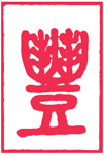
The ideograph of Feng, Abundance

The ideograph of Feng takes the image of beans flourishing to express abundance. The ideograph consists of two parts. The lower part is a cooking vessel. The upper part shows the stems and leaves of beans. The overall picture is one of flourishing and abundance.

Continuing the geopolitical Yi Readings, and from picking up a lot of chatter about upcoming offensives which may escalate, possibly even to nuclear exchanges, I wondered out loud if maybe such speculations are overblown if for no other reason than clearly there seems to be some sort of agreement between the two main antagonists to keep all the kinetics on the black soil ‘killing fields’ of Ukraine. The Yi seems to indicate that skepticism is warranted.

Of interest is that the Primary hexagram 55 arose a couple of days earlier. And today I consulted on another matter – the meaning of life (!) – and got #9 for the third time in only six queries. I don’t know what those odds are, but borderline astronomical. I am presuming there are important, timely messages in the ether involving #9 (and now also #55 which usually indicates some sort of climax or zenith) so intend to spend a little more time on this latest #9 before publishing the document. As it is, #9 the Power of the Meek, is now involved with the journeys of both RFK Jr and President Xi – and now the Meaning of Life!

My personal feeling is that when particular Hexagrams start coming up again and again despite very heavy odds against, that it’s a sign of something important, though do not pretend to know what.

Yi Reading: 2023-4-8 Does President Xi have good geopolitical intentions? 9,1 > 57 < 38


Hexagram #9

Asking about Xi yielded the same Hexagram #9 as asking about RFK Jr a few days ago. Different changing line, but still, that’s quite a coincidence. Hopefully it means they will work together at some point.

Yi Jing: Can any President rescue the Republic? 43,1 > 28 < 1

Yi Jing: Can any President rescue the Republic? 43,1 > 28 < 1


On 2023 03 30, about a week ago, I queried: “can the neocon era end without war?” and the answer was encouraging but also a little curious in that it posited a great ‘dragon arising from the field,’ a strong leader essentially, who would be able to rescue the situation which now featured evil, or low, people in charge keeping good people out of power. Yi Reading: 2023-3-6 Can the Neocon era end without war? 1- 2,3 > 33 < 1. Interestingly, the very significant Hexagram #1 came up in that one too: 1 Creative Potential > 33 Retreat < 1 Primordial Yang.

Today I asked the Yi if it would even be possible for a strong President to ‘rescue the Republic.’ This because many feel that the Republic has been floundering – at best – since the assassination of John F Kennedy whom – it has finally been published semi-officially – was murdered with the assistance of the US’s own intelligence agencies, a truly shocking thing of course, but it has been so many decades since it happened that all involved are all deceased. Recently a populist was elected and from the day after the election was subject to unending attacks and accusations, nearly all of them false, and never given the chance to govern properly beset as he was with most of the political establishment, including domestic intelligence and Big Tech media, arrayed against him. Even if all the neative stories about him were true in terms of his being unsuited for the Presidency, he nevertheless was duly elected and sworn in and as such deserved much better treatment. In attacking him the way the American Body Politic did, they degraded themselves and their country far more than he could ever have done and the nation is reaping the harvest of such degradations today.

Be that as it may, the question stands: assuming a really, really brave and good President were by some miracle to be elected, would he be able to save the Republic, by which is meant overthrow the corrupt elements which have captured it? The Yi has given a fairly resounding answer in the form of Hexagram #43, Breakthrough or Resolution. ‘One must make the matter known at the Court

Well, we shall see, but with all these Yang lines (with this Cast 15 out of 18) something heavy will be coming down, that much is for sure…

Yi: Will the EU soon dissolve? 55,1 > 62 < 28


Continuing this geopolitical series of Yi Jing consultations, today we turn our attention to Europe, partly because of the unusually intense riots underway in France, but mainly because the entire conflict in Ukraine ultimately may affect European nations more than most others world wide. No matter what transpires, they are between a rock and a hard place. On the one hand, enjoying good relations with Russia – which is technically part of European civilization, and now arguably upholds many of its foundational elements, being more traditionalist and ‘conservative’ than most Western polities these days – would be a good thing in an ideal world. On the other hand, the neocons et alia in the US and various corridors of power in the West have clearly made it a core mission to antagonize Russia, using Ukraine to drive a wedge between Russia and Europe in ways which seem to provide almost no benefit to any party involved.

So Europe is in the crosshairs even if all the fighting is in Ukraine. Not to mention that not a day goes by without some mention about how we in the West are, or need to be, helping Ukraine with funding, weapons, military services (such as spy satellite data and military training) and so on, making this clearly much more than a simple Russia-Ukraine civil war.

For Europe to realign with Russia they would have to break with the US. More importantly perhaps, the various nation states within Europe, each with clearly definable cultures and histories, would need to break with the EU. If Germany, for example, wants to exercise feeling free and able to make decisions in her own interest on her own without having to defer either to the EU Central Authority in Brussels or to the neocons dominating US foreign policy, she would have to break from the EU. Same for all other countries in Europe.

The question ‘Will the EU soon dissolve?’ – admittedly loaded in thrust – implies wondering if European nation states will once again be sovereign. So the question basically involves whether or not the centralizing power that is the EU as an institution will (or should) endure. In this context, it’s quite interesting that the Nuclear 28 in many texts basically says that ‘things cannot keep going on this way, they have reached breaking point.’ Also, as mentioned in the pdf document above, all three hexagrams feature two solid lines in the middle clearly highlighting this centralization issue. That said, given the 62 Derived which recommends coming back down to earth versus flying too high, it seems this centralized dynamic is problematic, especially given the unstable first line, the foundation of the EU’s Abundance, leading away from interconnected Fire into Mountain which often means stopping. So if the idea is to stop flying high and also possibly even to stop altogether, that seems to imply that the EU itself should indeed soon stop.

Put another way, holding everything together in the middle in the centralized fashion of Hexagram 28 ䷛ seems too much because it probably no longer benefits the individual members equally since each may have different interests and needs. The stresses and strains evidenced by the huge, costly and deadly military confrontation in Ukraine is probably going to make this increasingly clear as time goes by as the rigid centralization principle inherent in the European Union bureaucracy in Brussels becomes more and more of a burden for its member nations. Given the ’10-day’ timeframe in the Line 1 commentary, I’d say that ‘yes, the EU needs to dissolve fairly soon.’

Yi: RFK as candidate for President 9-5 > 26 < 38

9 Soft Power > 26 Contained Power < 38 Discord


[excerpt from the text:]

Preliminary Summary

RFK is an iconic presence in American consciousness as a young boy whose uncle and father were publicly assassinated. In a way, this young boy is represented as Hexagram 9, a yin line in the 4th place surrounded by 5 yang lines. A significant but diminutive figure in an overall 5-yang-line powerful context. 26 indicates Greatness contained within lofty, majestic mountains. Like his father and uncle, he can access this greatness and inspire people to follow him. The fact that 9 and 26 are the only two Hexagrams dealing with storing up power and that the Changing Line links them together is auspicious. 38 indicates a process involving continuous disagreements; the ideogram depicts people side by side with different views; nothing unusual in this given the political context. In sum, this Cast indicates that RFK has significantly great potential as a candidate but it’s too early to say much more than that given Accumulation / Storage is obviously about potential, not yet full fruition.

2023-4-5 How can Russia-China create High Culture?

Good Manners 22-1,3 > Peeling Away 23 < Liberation-Relief 40

In the comment section from a previous High Culture post, one of the issues involved ruminating – as is this substack’s official wont – about how such a thing could come about. Of course perhaps first there should be more explanation about what it might be, but in any case we both agreed that it was not something that could just be instantly imposed somehow. These things take time. Meanwhile, back in the real world, as I mentioned in a subsequent comment, a well-known geopolitical pundit Alistaire Crooke at Strategic Culture had recently opined about this topic, albeit only tangentially and not in any depth, namely:

“To be very plain, the western liberal cultural revolution’s shift from being merely adversarial to a project not aimed just at rejecting previous cultural forms, but in erasing them altogether is what is being globally rejected and collapsing. A new moral-cultural sensibility is rising, even as formal institutions of religion have ebbed. It is that which is articulated by Presidents Xi and Putin. Again simply put, Russia’s quiet, background revival of Orthodoxy and China’s of Taoist and Confucian values as the possible framework against which the regulation of modern technological society can be set – in no small part – has opened the path to metamorphosis and the inflection gripping much of the world.”

There are two main issues here, to my mind (among many more).

  1. Having excised many of the institutions which promulgated and protected ‘high culture’ what have we replaced them with and can they generate high culture once again?
  2. Do Putin and Xi have the ability to do what that quote says, namly to create a new ‘moral-cultural sensibility’ by pursuing a ‘quite background revival’ of their respective Orthodox and Confucian-Daoist values as ‘the possible framework against which the regulation of modern technological society can be set.’

My answer to the first question, deserving of a book let alone more articles but which I am not qualified to answer in any substantive fashion, is ‘No.’ We got rid of Monarchies with executive power who were also heads of the Church; we got rid of the Church as dominant powers or even influences in our societies; we got rid of the location-based hereditary aristocracies, the class from which the Monarchs, as fellow peers, emerged. Now maybe we got rid of them for good reason to do with systemic corruption that was deemed irreparable (as many now believe is the case with the West). But they existed for reasons that are almost too basic and profound to explain clearly – certainly not in contemporary politico-social terms. Modern Westerners have little concept of true Royalty, an influential Church binding all of us together in the same worldview, faith and moral code, of an aristocracy that similarly knits together local communities as part of some larger, sacred whole and which also wields life and death authority where needed to protect all from any evil doers in our midst. Aristocracy, at root, means ‘rule by the best among us.’ It is arguably the best system. (Who else but the best among us would you want being in charge?) But like all systems, it can be corrupted. All systems.

To my mind a ‘high culture’ creates meaningful lives for all in that society and in so doing evolves increasingly subtle, sophisticated, compassionate and enlightening mores in terms of speech, dress, the Arts, manners, design, honour codes, foreign policy and all the rest of it. There is a view of life and living which permeates all that is said and done in that society, moroever from top to bottom. And being of such a high moral nature, it has ways of fending off those who wish to take advantage of the goodness and wealth of its polity and thus preventing systemic corruption from taking root. Once a society loses its way, its moral, ethical and wisdom-compassion compass, as it were, it becomes subject to the malevolent ministrations of those mentalities which exist in all cultures and polities and will fall prey to their venal pursuits. We see this now in the West, in my opinion.

So: I decided to ask the Yi Jing what it might have to say and posed the question: ‘How can Russia-China create High Culture?’ And the Jijing replied, interestingly, with Hexagram 22 often translated as Grace, Adornment, Vanity, but it also could be Etiquette or Good Manners. Interestingly, some of the (too many) commentaries I consult mention that in an evolved society there is no need to enforce laws since people will follow them naturally if they have been sufficiently educated, one aspect of which in any complex ‘high society’ is ‘good manners’ which – at least in the postwar England I grew up in, are said to ‘make man.’ Perhaps they can also be said to ‘make a high culture civilization.’

It seems to me that in order to establish a New World Order that promotes Enlightened Society of sorts, that any attempt to do so by establishing some sort of new Central Power with the mandate to enforce compliance would fail since that power would be subject to corruption by those mentalities attracted to such irresistibly tantalizing bait. Inevitable. No, it will need some sort of almost formless Round Table principle which, interestingly, resembles the sorts of coalitions that the Russia-China Axis seems now to be building. Russia and China have been symbiotic allies for at least ten years now, for example, and seem to be operating on the principle that neither is above or below the other. They are operating, in other words, as Peers of the Realm, as true aristocrats. Furthermore, they are not publishing Rules that nations joining their various coalitions such as the SCO and BRICS. These are voluntary associations of sovereign (‘peer’) states who are being made welcome to take a seat as fellow equals at this geopolitical Round Table. As long as they don’t create a new enforceable Rule of Law, they might succeed in creating a better way.

Or put another way, if everyone involved behaves properly (good manners again) there can be no discord. It simply won’t happen. So though this is very vague, indeed bordering on non-existent as those used to commercial law and criminal statutes might argue, in fact it can also be definitive in terms of real world results. If all simply practice ‘good manners,’ all will be well. Confucius may be right to have dismissed this Hexagram as depicting a dynamic which doesn’t serve a Leader well for resolving Great Matters, but perhaps he missed a deeper, more subtle point of view: by observing the niceties, no Great Matters need arise, merely the obligation to decide how many cucumber sandwiches one wishes to consume with one’s Pimms Nr. 1 cup whilst watching the cricket match of a lovely summer’s afternoon!

Anyway, it is a charmingly auspicious coincidence how we were discussing these issues and that so many of them were instantly reflected back by the Yi, with various pointers from antiquity to boot. This often happens. It may not be ‘magical’ exactly, but it also cannot be explained with rational logic alone. That’s just the way the Yi Jing is. (And that’s the way we like it!)

About High Culture – a comment

(From a CJ Hopkins substack article)

Here is a comment composed this morning in response to someone else’s:

Navyo Ericsen (https://substack.com/profile/23378208-navyo-ericsen)

Writes Fear or Love

20 hr ago

I agree. However, what CJ misses in his excellent and valuable critique is the innate love within human beings which is sidelined, ignored or even understood, and that that love is inherent in any spiritual belief, or for that matter living without spiritual belief. It’s our common denominator and I feel it will get us through all of this. The rest of it – what CJ outlines, really – is just performative, utilitarian accounting which has no depth of meaning whatsoever.

Random Ruminations [Me!]

16 hr ago

That is the essential ‘high’ aspect in ‘higher culture. Which has been excised from our cultures these days. So here we are…

Navyo Ericsen Writes Fear or Love

7 hr ago

So let’s get it back.

Random Ruminations

6 min ago

Deep topic!! The lives of individuals are infinitely rich in unending vistas and terrains, victories and defeats, growths and declines, progress and sidetracks, wisdom and temptations and so forth. So much more so in the case of societies.

When Putin says that he has received the civilization of Russia from his ancestors and intends to ensure that his people can pass it on to future generations of Russians, and also that he won’t allow others to destroy it without putting up a fight that makes sense to me. For such civilization takes generations, indeed centuries to develop. It is a very real thing if impossible to describe except via artistic, not scientific, expression. And nobody would care about such a thing unless it did not have a beating heart at the core, something precious and special, alive, sensitive, passionate, feeling, human – very human. These skeins are expressed culturally in language, dress, cuisine, customs and institutions such as Royalty, Government, Church, Festival, music, art, political discourse, literature and so on. The ‘high’ part of it – when working well – suffused through all elements high and low. Even the yakuza and Tongs are fiercely patriotic, after all, even if they are also cutthroats and pirates in practice. Honour systems are always present in high cultures too. Ultimately the high aspects have to do with goodness, discipline, honour. And ultimately they all come together in the mutual creation of sacred spaces, sacred perception. Such was the inspiration behind the great cathedrals of Christianity, an inspiration that transcended the power politics of prelates in Rome which gradually spread its corruption throughout the nascent civilization. For there is always corruption in any complex organism or institution. The challenge is how to recover from it.

The Chinese Hexagram #18, sometimes translated as ‘Work on What has been Spoiled’ could also be called ‘disease,’ ‘corruption’ or ‘recovery.’ It depicts five of the most poisonous animals locked together in a jar. The one who survives has the most potent toxin. This toxin is then used as medicine. For disease and corruption show the path forward. Such imbalances arise from mistakes – sins, crimes, laxities and so on. Correcting those mistakes makes society better but the institutions must have sufficient wisdom, integrity and mandates to do so. In this way the society maintains its high culture and indeed improves it over time. Of course only if it is truly high manifesting bedrock virtues which do not fall into the traps of empire-building, totalitarian control, egomaniacal tyranny and so forth.

The problem with the revolutionaries confronting corruption that has been allowed by a lax civilization to fester for far too long is that they know only how to destroy the old. They have no notion of how to rebuild afterwards. And again: good cultures, aka civilizations, take centuries to create, warts and all, so destroying them should never be an option, rather pruning and trimming to promote this aspect over here whilst reducing that aspect over there rather than simply chopping everything down and bringing out the builldozer. If that does happen, then perhaps it is best to follow the old ways: kill all the defeated, rape all their women so their offspring are the victor’s and the previous civilization – like so many before – simply vanishes forever rather than limping along as some sort of ghastly deformity.

In any case, it seems we have destroyed Western civilization at this point. Maybe it can be rescued, but I suspect that having bulldozed away both Royalty, the Church and the traditional location-based Aristocracies that we have simply failed to replace them with other elements which organically and authentically manifest the same deep cultural wisdoms and functions which spawned them over time. Yes, they may well have been corrupted (though history is told by the victors so hard to tell, frankly – reports about Tzar Nicholass II, for example, vary wildly depending on source) but destroying them wholesale was incorrect for sure, and we are all paying the price for that today, arguing about various -isms without being able to understand a single one.

Well, that was much too long a reply.

And not nearly long enough!!

===========================================================================

Additional remarks for this post:

Personally, I think this is a very important topic but I do not recall seeing it being covered anywhere at all, though surely it must have been. We are all like lower order creatures who just paddle around in whatever mess has been made for us without any notion of choice or alternatives. Somebody overturned all the bowls and plates on the high table and cast the leftovers willy-nilly onto the ground and we all scrabble around feeding off those scraps without any seeming awareness of the table above from whence they came.

And yet on some level we all do know. Just like we all know right from wrong, honourable from dishonourable, those worthy of respect and those not worthy. We all know these things instinctively. Even most animals know them. Humans are social animals born with spiritual and moral compasses on a journey of learning leading to wisdom and compassion. We all know this. And good civilizations manifest this in no end of different – often marvellously different – ways.

The big battle of our age is upon us. On the one hand there is a vision of a multipolar world which cherishes all the many and varied civilizations in the world built over thousands of years since the Great Flood, the last cataclysm after which we started over, at first in tiny groups of bereft, impoverished survivors, later in emerging populations and societies, rising and falling interminably beyond the scope of written and aural memory. What for Plato was a questionable but most likely true tale of Atlantis (recently identified finally as a location in Western Africa resembling his descriptions remarkably well) is for us now only a myth; and even when we discover the likely location, the bare, almost shapeless ruins tell us almost nothing of who they were and how they lived so they remain only a myth. That high civilization is now lost.

But facing the multipolarists are the unipolarists. However this is not so much the so-called Outlaw US Empire, a hegemonic nation state based in a geographical location, or a race of ‘Anglo-Saxons,’ as a system, a way of doing things. Some called it technicity, I believe, or more simply a technocracy. Whatever it is called, we may soon all find ourselves digitally bound together in some sort of post nation state One World system, and quite possibly the same people and nations advocating multipolarity will take us down that road too.

All major nations today are experimenting with CBDC (Central Bank Digital Currencies) with the intention to issue them fairly soon, they say. (Interestingly, Ukraine was one of the nations in the Euro and near-Euro zone most advanced in this.) They will no doubt interface seamlessly with each other globally, no doubt on some level not beholden to most ordinary users like ourselves. Every penny spent or received will be automatically tracked, every purchase with time and location logged and linked to job performance and other social behaviours. The identification procedures to access such currency will no doubt also provide or prevent access to various locations or services. The digital technology will create a virtual totalitarian society world wide in which quaint notions from Common Law such as privacy and individual or societal sovereignty will have gone the way of the dodo. It will be a Brave New World indeed.

Meanwhile nobody really examines what makes a civilization great, not in terms of might, but in terms of humanity, wisdom and compassion. Or, in the terms of the comment exchange above, what makes a ‘high culture’ or ‘high civilization.’ For without that quotient, or element, all systems will fall victim to inevitable corruption. All. However with that quotient they have a chance to do well, sometimes even for several centuries in a row. But unless the society has awareness of those elements which make for a high civilization they will not be able to both recognize them and protect against various corruptions, individual and collective, which will degrade or even destroy it. At this point modern developed societies have no mechanisms for such self-correction because they have strayed too far from their sane expressions by destroying too many of their core institutions – equivalent to central pillars and arches, nay foundations.

Put simply: we have lost a shared sense of what makes for a meaningful life.

In short: it ain’t lookin’ good!

Yi Jing: an original Sequence of Hexagrams #1 to 30.

Sequence 1-30

Before the beginning are Heaven, the spark, and Earth the responding material flame of manifest being. Then comes the seed of life (3) sprouting, struggling to emerge from within the Earth, dark skies pouring with rain above. From which comes childhood (4), learning, the seed having all it needs to grow into the mighty oak but having to go through the process of learning what it already knows on a deep level. Then Wanting and Needing (5), a period of waiting for development. Then (6) obstacles put on the path by social structures and so on. Then (7) the need for socialization, organization, then (8) joining society, becoming a full member; then (9) learning to tame oneself therein lest one encourage egomania; then (10) encountering others vividly, learning to handle their energies, then (11) achieving some sort of balance or (12) becoming stuck with too many contradictions or complexities not adding up; then (13) fellowship, comraderie, doing things together then (14) some sort of actual accomplishment and power which (15) must be tempered with meekness, modesty lest mania develop again, thus some true nobility from which (16) enthusiasm and accomplished joy flourish forth along with (17) following, for a positive path is being made which others can join in after which (18) corruption is inevitable and so learning to deal with that is next from which (19) comes a sense of true inner growth as one’s maturity develops into (20) contemplative view, seeing good and bad, high and low as part of the same weave wherein (21) cutting through deception becomes a necessary art so that (22) emptiness of all forms is appreciated directly and then (23) deconstructing that which is apparent and yet not solid, that which creates obstacles and yet is not extant so that (24) one can start all over again with a new cycle, the same and yet no longer the same, (25) innocent, natural and yet not without experience, (26) able to connect with with the wisdom within, of the ancestors and sages thus knowing (27) how to nourish oneself and others, fostering the good, avoiding the bad, when to move forward, when to be still, how to reduce (28) when there is excess, as there inevitably is, and how to penetrate the depths of one’s being (29) and meet any challenge or hardship and how to master the arts of war and wisdom (30), wearing physical or spiritual armour as the situation demands.


Most versions of the Yi Jing have a section at the end with various elements from the original collection of the texts – Great Commentary, Shuo Gua (trigrams) and so on. Usually they also have a short chapter with the Sequence, one in traditional order (1-64) others in irregular order. On awakening this morning I suddenly though through a 1-30 sequence myself published above.

About the Sequence: the purpose of the Sequences, to my mind, is to help bring each Hexagram to life with its own character and story to tell. They are archetypical expressions of basic ways which reality manifests. Reality in the Yi is Heaven Earth and Man. In other words, it is not merely either material or philosophical-metaphysical reality or social reality but some combination of all three, aka ‘human experiential reality.’ So the Heaven in the Yi may refer to profound principles, but mainly in the context of how we can experience, view or access them in our lives as living humans. Every moment of every day we live in the world of Heaven, Earth and Man in that, materially speaking, there is always Sky Above, Earth Below and Man walking his and her way in between, on the Journey we call Life. Every moment this is going on and of course it’s not just true in the external material physical sense but also in the emotional sense. We have a sense of Mind (Heaven), Body (Earth) and ongoing journey of experience with ups and down, victories and defeats, failures and success (Man). When we have an idea there is the initial void from whence it comes (Heaven) then some sort of actual expression – a word, a brushtroke, a note, whatever – (Earth) and then how we play with that, make something of it, derive meaning or go further (Man).

The 64 Hexagrams take the eight basic energies of the Trigrams and by putting one atop the other create eight time eight hexagrams which comprise a universe of basic energy or situational patterns. We can get some of the story by putting together various qualities from the lines. There are associations made with yin versus yang lines. There are differences between the bottom and the top of the hexagram, the bottom being the lowest and first, the top being the highest and last. There are relationships between the lines such as correspondences between the first, second and third lines of each trigram (1 with 4, 2 with 5, 3 with 6). There are relationships such as yang on top of yin or yin on top of yang. Yang in the 4th place instead of Yin in the 4th place. Lots of things are going on with these Hexagrams so lots of intuition can be sparked.

Plus millenia ago, people gave pictures and names to these Hexagram to nudge our interpretation. The King of Wen spent seven years locked up in a courtyard with nothing but sticks and bare earth to play with so put the Hexagrams into the order we see today from 1 to 64. And to explain that order, he developed the characteristics they still bear today, although any good Yi – Consultant can see past the text into the trigrams and lines and relate them to the query when he so chooses.

The purpose of the Sequence is to give each Hexagram a context in some sort of inter-related unfolding story or structure. Knowing the nature of what is before and what comes after helps give a sense of character to the one being examined. Such things are not carved in stone. But they can be helpful. Most editions of the Yi have a line or two mentioning the Sequence. This is not to be pedantic but to help give a feeling for what sort of dynamic is in play. They usually only reference what came before, but I think they should also reference what comes after. Why not?

I believe the First Book is Heaven and Earth and the last book 31-64, is Man. So the first book is a little like the main cards in a Tarot deck, the more fundamental dynamics, beginning with Heaven and Earth and ending with Moon (29) and Sun (30).

In any case, there is my humble offering above. Just writing it out was interesting and has informed not only how I view those first thirty hexagrams but also my understanding of why they have been publishing those Sequences in the first place.

Homage to CTR

April 4th is the anniversary of my teacher’s death in 1987. This is a poem spontaneously composed in fond remembrance.

Homage to CTR

now beyond the highs and lows

the yeses of staying in

the no’s of being out already

and who knows anyway

only the nose knows

entering the safe harbour

of your port-soaked breath

now a veritable highway of memory

illuminated by the well-ordered symmetry

of Shambhala government

who miraculously pay the taxes

extracted from this

extorted from that

beyond blessings or lament

ecstasy or torment

– and yes, I remember the summer of ecstasy well with all those weddings!….

Who is exhausted when remembering your inexhaustible naughtiness?

Who is reverent having been taught to ransack kleshas and show no mercy?

Who is regretful when every moment is a glorious dawn of present realization?

Who isn’t secretly proud that the whole thing blew up in our faces?

That we made a bigger mess out of it all than even you, the great Vajra Artist,

The Master of Vast Cosmic Vajra Mess and Vajra Disaster,

than even you could imagine,

how soon we’d drop the ball

and let it bounce down and around a back alley corner somewhere

into oblivion?

Well, many of us now volunteer exiles,

out in the cold

freezing in the midday sun of unquenchably thirsty samsara

parched for the Dharma

which nevertheless keeps oozing out of every pore

with every breath we recall your name

your song

your laughter

our family

our youth

our glory

our first chance

our second chance

our living legacy

which can neither be abandoned

nor forgotten

nor cheapened

nor honoured or dishonoured

now we are out in the wild

alone at last

preparing

for

that last breath

that final

plunge…

After reading Ellen Mains letter from long ago,

And then the discussion,

Spontaneously Composed song of an exile,

On the Evening of another Parinirvana April 3rd 2023

Veracruz, Mexico.

Ashley Playfair-Howes

Baron of Bras d’Or

Celtic Buddhist Lineage Holding

Fool.