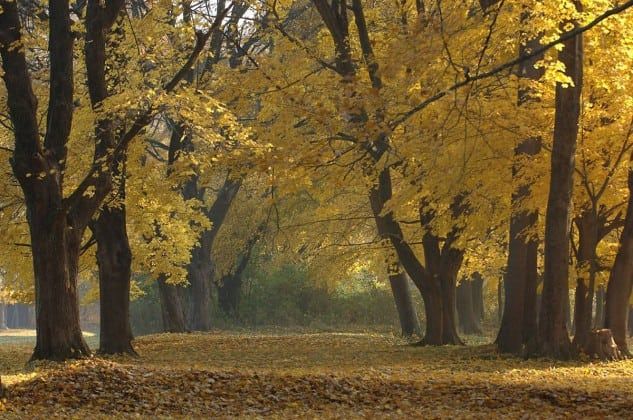
late autumn leaves by bridge in the Berkshires (near where I was born long ago…)
.
is this how it goes?
techno-feudal apocalypse
no bang, just whimpering
#41 21/11/2021
.
just another coldor flu?
or apocalyptic angel of death
in pandemia-landia?
#42 21/11/2021
.
apocalypse now:
our lives like autumn leaves
blown away in winter storms
#43 21/11/2021
.
of all ever born
all will ever die
nothing ever happens
#44 21/11/2021
.
abstract musings
far less weight
than ripe orange falling to earth
#45 21/11/2021
.
compliance resistance
worry indifference…
all is futile
#46 21/11/2021
.
when most of us are gone
who will be left
to read these haiku?
#47 21/11/2021
.
caught from friend or stranger?
is life soon ending?
either way: no matter
#48 21/11/2021
.
lying down quietly
listening to Gregorian monks
Ginger* is happy!
#49 21/11/2021
* Ginger is our adopted stray labrador-spaniel-ish ginger-coloured dog
.
birds chirping raucously
whose song will emerge victorious?
simple pleasures…
#50 21/11/2021
.
like beads of water from last night’s rain
hanging from outstretched drying rack arms in cold morning shadow
soon we’ll evaporate in late morning sun
#51 21/12/2021
.
fall in lennox
Commentary:
Though limiting my reading about world affairs these days, every once in a while I select a few articles and plow in. This morning I read some about vaccine after-effects world wide now there is almost a year’s worth of data. Of course there are many disagreements as with everything these days but the sources I feel more comfortable trusting – mainly epidemiological specialists and clinical doctors – are painting a disturbing picture indicating that the spike proteins generated in the body after receiving the mRNA gene-editing shots (they are not, strictly speaking, ‘vaccines’) are pathogens engendering chronic micro-clotting which ends up causing various forms of thrombosis, most of which over time may shorten the lifespans of those so injected. Given the vested interests clearly blocking widespread dissemination of the results of any such research we will probably never know the full story. What is known in the UK, for example, is that the overall death rate this year is significantly higher than last year and higher than the general trend over many years especially so with young people who are not susceptible to covid but many of whom have now been injected. Needless to say, if this is more or less the case, it’s a world wide catastrophe on a scale few of us have the ability to imagine let alone face collectively.
So in contemplating these articles I gently slipped into a ‘what if the world is ending’ mood and wrote the above series of haikus one after the other in a matter of minutes.
As with nearly everything on this blog they are artistic offerings not prosaic calls to outrage or activism. The pandemic or possible apocalypse – like everything else including our very lives – is both real and fictive, part of a living dream. Things can be felt deeply (or not) but ultimately we are all passing shadows, flowing rivers here today and gone tomorrow. We can mourn our passing whilst also celebrating our brief time alive. This series went through a little progression along those lines though they were written out spontaneously one after another with no particular agenda or goal in mind – just mood-painting perhaps.
Picture a young man in his mid-twenties raised in England now living in America on a work assignment in England spending a month in a red brick facility in County Meath Ireland. It’s 1981. The last night of his all too brief sojourn in Ireland – as it was then called – was truly memorable involving most of the old people in this rural area getting together in the local pub to sing, ostensibly for the benefit of this young foreign visitor. So this is an account of various memories in and around that event.
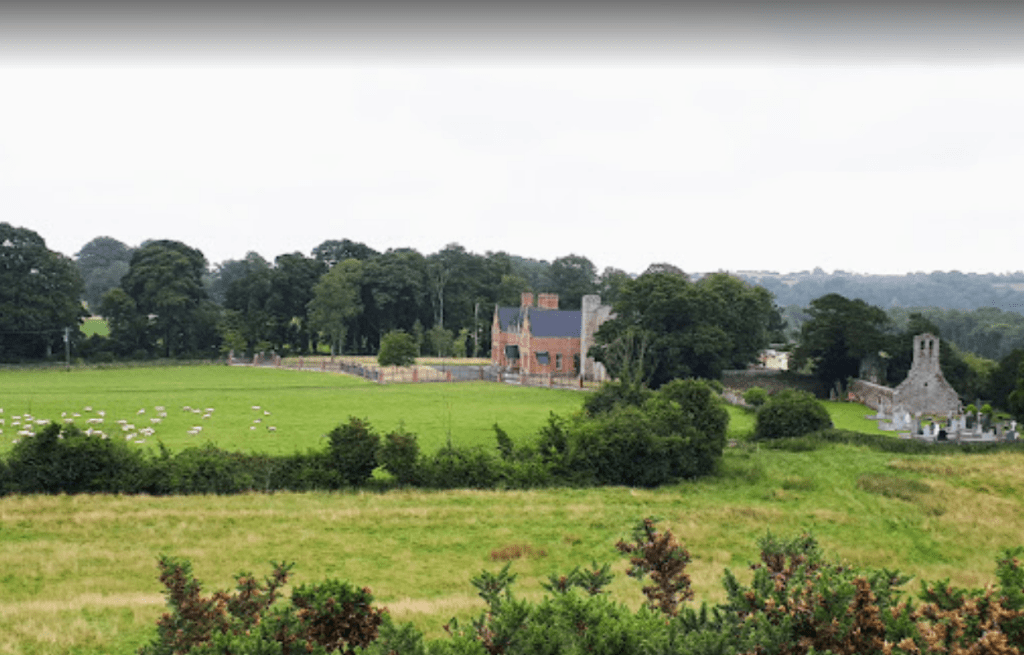
Netterville Institute, County Meath, Ireland
First, a little background about how Ireland looked through this young man’s eyes. He had been raised in England and had attended posh schools like Harrow – which tormented illustrious luminaries like Lord Byron and Sir Winston Churchill as much as this particular young man. His last year at Harrow whilst studying for an A-level in History, he spent long hours in the largest private library in England poking through lots of extracurricular albeit tangential material, one volume of which he found tucked away somewhere providing statistics about the Irish Potato Famine.*** In this tome he learned that the typical diet for an Irish working class family featured potatoes every day and meat just once a week, usually bacon or chicken, so that when the potato blight struck millions starved (and New England soon gained a population that would provide them with more indentured slaves as well as police officers a few generations later).
The young man felt that learning how the Irish only ate meat once a week was a significant thing to know and he built a whole theory of ‘real history’ around it, a theory which posited that nearly all the official history he had been learning in the Cambridge History of England whose many volumes he had been studying for years was little better than glorified bunkum. All these endless chapters on Kings and Queens and Talleyrand and the Duke of Wellington – like today’s inordinate coverage afforded Presidents, NFL quarterbacks and comic book heroes – kept ignoring how real human beings actually lived in those times, how they saw their own contemporary reality. Ever since this flash of insight in the darkened reading areas of the Vaughan Library in Harrow-on-the-Hill, the young man felt he had great insight into and close affinity with the Irish people so he was most eager to spend a month there to reconnect with these hitherto unmet soul mates.
Needless to say, such deluded notions soon faded once he actually arrived but the sense of affinity remained throughout his time there and indeed to this day though probably this has less to do with any spark of insight triggered by the Potato Famine statistics and more to do with a spontaneous love for this very old and refreshingly mischievous though historically battered people whose IQ’s consistently score above nearly all other ethnic groups world wide.
The title of this piece is ‘A Night to Remember.’ Truth be told, not much of that night is remembered, though a description soon follows. But there are other scattered memories of this brief time in Ireland which form the experiential backdrop of how significant this night felt at the time, memories and impressions which shall now be shared in no particular order.
The food: the cuisine was nothing to write home about but the ingredients were extraordinary. Despite having lived years each in upper class London, at a chateau in France in the Loir et Cher and in Florence never had he tasted such nourishing-feeling sausages, butter, cream, eggs, bacon, bread, potatoes and vegetables. It was like everything was twice as dense as anything else he had ever tasted. And this was still back in the days when produce in rural France, for example, where he spent two years in the early 1970’s, was a cut above most produce in upscale West End London which itself was above most of the rest of the country. But the produce in Ireland was like nothing he had ever tasted before and made a deep impression. In this regard, breakfasts were the main meal of the day. (This internet photograph does not do the subject matter justice!)
Hearty Irish Breakfast!
The countryside: it is said that Ireland is the ‘seventh step to heaven.’ Perhaps this is because especially when cloudy overhead it seems like you can almost reach up and touch them, the sky feels so close. Indeed, it feels like you are living up high with the gods even though most of the country is barely above sea level and pretty much everywhere you go on this ancient island there is a salt tang in the air. This sense of being up high with the gods somehow complements the exceptional variety and vividness of green prevalent throughout the country. This sojourn took place in already cold December but everywhere he went he was met with almost psychedelic intensities of no end of different shades and textures of exceptionally vivid green; to exaggerate only a little, it was a little like living inside a van Gogh study of a cow pasture.
From the pasture next to the Institute
The people: the people he met on trains and in shops were crude, often unfriendly and charmingly obnoxious. The women were Catholic and reserved with a single foreign man – unusually so compared with other young women of their age in nearby European countries – whilst the men were brash, daring, provocative, amusing with nearly everything coming out of their mouths some combination of irreverent, insulting and witty – the cruder variety boasting about lewd conquests with young ladies and begging him to tell similarly lewd stories in return. He can still remember looking into their wild Irish bright blue eyes and being laughed at merrily, being challenged to see life as a dream and not be so bloody uptight about everything. It was both discomfiting and refreshing at the same time.
His most intimate encounter with an actual Irish person was with Dixie, the caretaker of the Netterville Institute owned by an American millionaire couple – whose guest this young man was. Netterville is a slightly ugly Victorian-era red brick construction next to a far older stone church in ruins, purposed as a Home for Battered Women. The next door neighbours, a family whose last name was, most inappropriately, Pigeon, were extremely hostile since they were about to seize the property which hadn’t been used for eighteen years when the millionaires purchased it – another two years and it would have been theirs by law. So they were always pacing around in the fields nearby glaring at the occupants with an evil eye. Our young man became proficient at seating himself in the main downstairs rooms in places where their glares could not penetrate!
Dixie had a slight limp and seemed the sort of man who had been an officer’s wartime batman, comfortable with service without being either obsequious or arrogant. He instantly cottoned on to what little Harrow remained in the young man and played a servant-like part and they got on very well. Dixie would occasionally come in after he had finished his superlative breakfasts and do the dishes for example, and also took care that a housekeeper came in to clean the floors once in a while. They didn’t talk much though he was delighted to provide little pointers of things to see in the area; but the young man was there on a working holiday finishing up a personal project which required quiet time alone so that’s mainly what he did. The twenty bedroom institutional building was large and cold with only a few rooms being in use for the single guest and generally uncomfortable so after a couple of weeks he found himself driving an hour or so to Dublin to quaff a few pints and take in the city buzz.
After several weeks of these many and varied impressions it was Dixie who came up with the idea of throwing a farewell party for this foreign visitor who basically knew no-one nearby. One day he mentioned in passing that the old folks in the area used to get together every Saturday night to sing traditional songs in English and Gaelic but since the advent of the television a decade or so earlier – they being about thirty years behind the times – the young people were no longer getting together in the local taverns like they used to and so the tradition was dying out and the songs were not being passed on.
“When’s the next time you’ll be getting together for one?”
“Well, Dixie said, we could put on one for you if you like. It’d be a good excuse for us to do it. Would you like that before you leave?”
“I surely would, but I’m behind on my project and have to finish up by Saturday evening before I leave and can’t do it before then.”
“Saturday evening it is then; you can meet us down there at the pub at seven o’clock.”
Unfortunately it took until eleven o’clock to be done at which point the young man drove down to the pub expecting them all to be in full throat already and nine sheets to the wind and no harm done, he could just blend right in hopefully. But no: they had been waiting, some patiently but others with mounting ire. Dixie made a polite, deferential speech about this visitor to the Netterville Institute – which no doubt further irritated those already so stoked – but those formalities dispensed with cheerful smiles broke out all around and they all got down to business: singing and drinking. Our young hero was served a Guinness which in Ireland is a truly superb beverage many grades better in quality than what is found in other countries for reasons they have never been able to determine but which of course is because only in Eire do the gods and spirits of that island permeate every ingredient and process that go into its making and consumption. Then, laying an elbow on the polished bar pretending to be an important, mature person worthy of their attention (which he was most certainly not on either count!), in his recently purchased Harris tweed bright green jacket with professorial looking elbow patches, he turned towards the forty or fifty souls eagerly facing him. And instantly realized that something special was about to go down.
A truly ancient old man slowly stepped forward in front of the naturally formed semicircle and in both English and Gaelic introduced the name and history of the song he was about to perform. He started in a subdued fashion with an old man’s feeble, wavering voice as if singing from far away and long ago but as he sang his spirit strengthened and then the entire assembly joined in, first softly and then with increasing volume. By the end of that song there was nary a dry eye to be seen for all were moistened with Irish tears of joy and sadness perfectly blended. Then many different songs ensued: ballads, bawdy, martial, ancient, modern, comic, deeply touching and so forth.
The young man found himself deeply moved, not only that they had waited for him before beginning what later transpired to be a clearly magical night for all but also because he was being given a deeply intimate and ‘real’ transmission into a world that used to be vivid and vibrant for all there assembled but was now sadly fading into the past making the whole experience poignantly bitter sweet. Although the songs were mainly in English with only a few in Gaelic, altogether it was like witnessing the passing of a sense of shared culture and community with those assembled knowing their time was now ending, their culture now fading, that their children and grandchildren would not share such things together as they had done. So along with lamenting such passing they were also celebrating that they could still come together and share what was still bright, luminous, precious and heart-warming for them in the present.
You could hear a pin drop, as is said, when that elder first stepped forth. The Irish have one of the keenest ingrained sense of drama and story in the world so everyone there had waited for this moment which would not have been the same had not the pretext for the gathering – hailing and farewelling a young foreigner staying at the Big House – been honored in some sort of formal way.
Although it was indeed ‘A Night to Remember’ and although he will never forget how deeply touched he was to be present at such a gathering with such depth and beauty of direct human to human transmission, the young man honestly cannot remember a single detail of what transpired that night after old man started the singing. Everything went straight to heaven, as it were, and cannot be recalled on this plane today. Truly, Eire is the seventh step to Heaven!
He can recall, however, that it was not until dawn was breaking that he returned to the Netterville Institute and it was a hard trip to Dublin later that day to catch the flight to London where even Chelsea looked wan and drab in comparison to the luminous heartfelt brilliance of the faces turned towards him in song at that local tavern in County Meath.
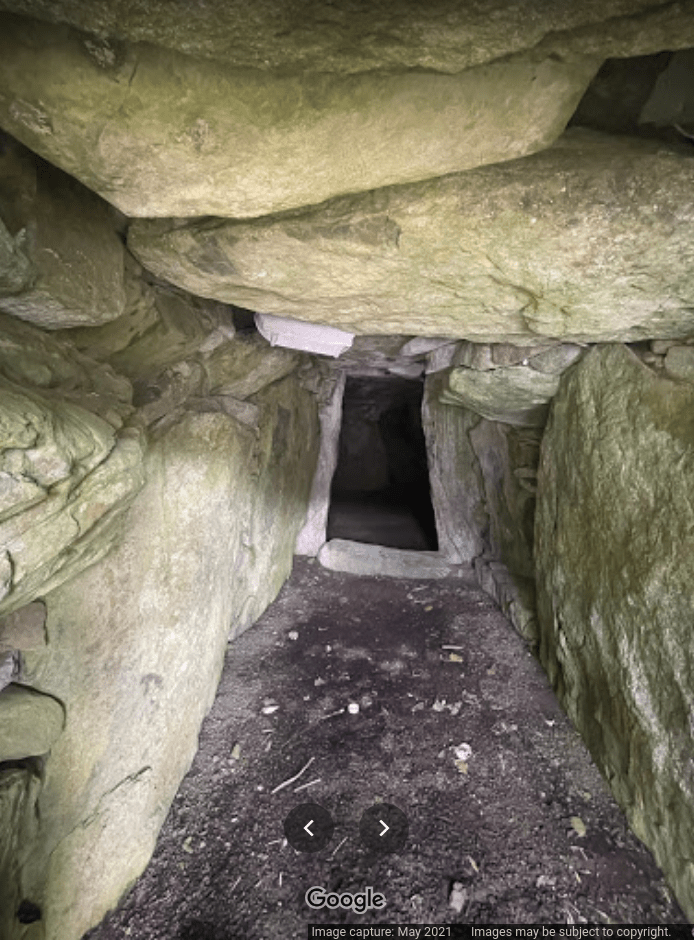
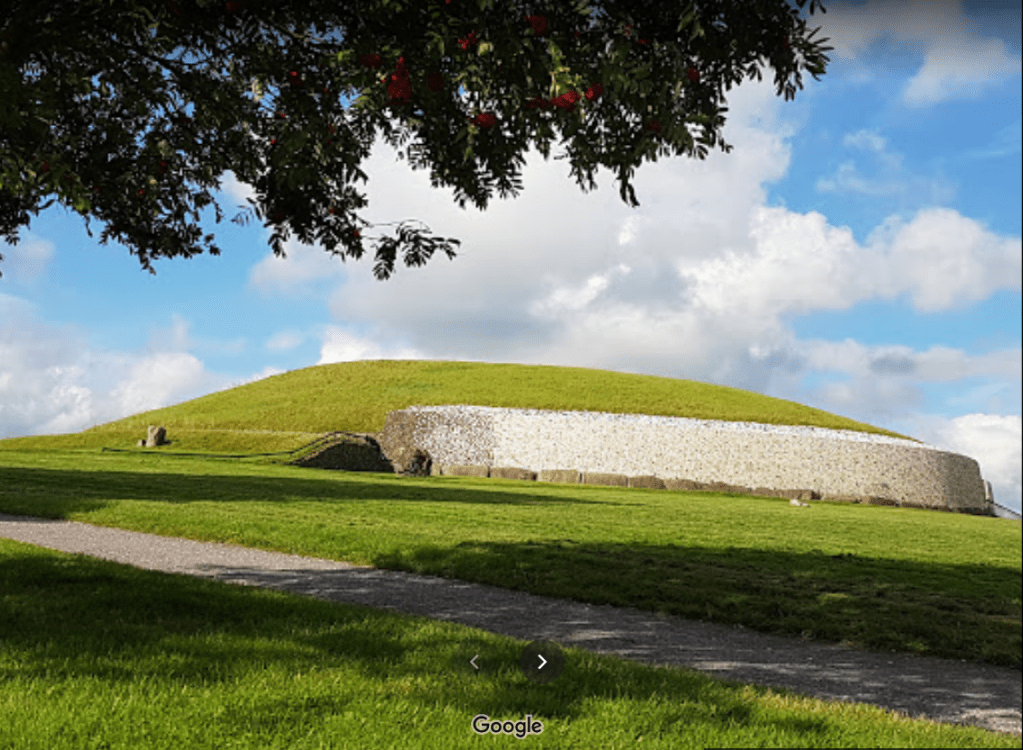
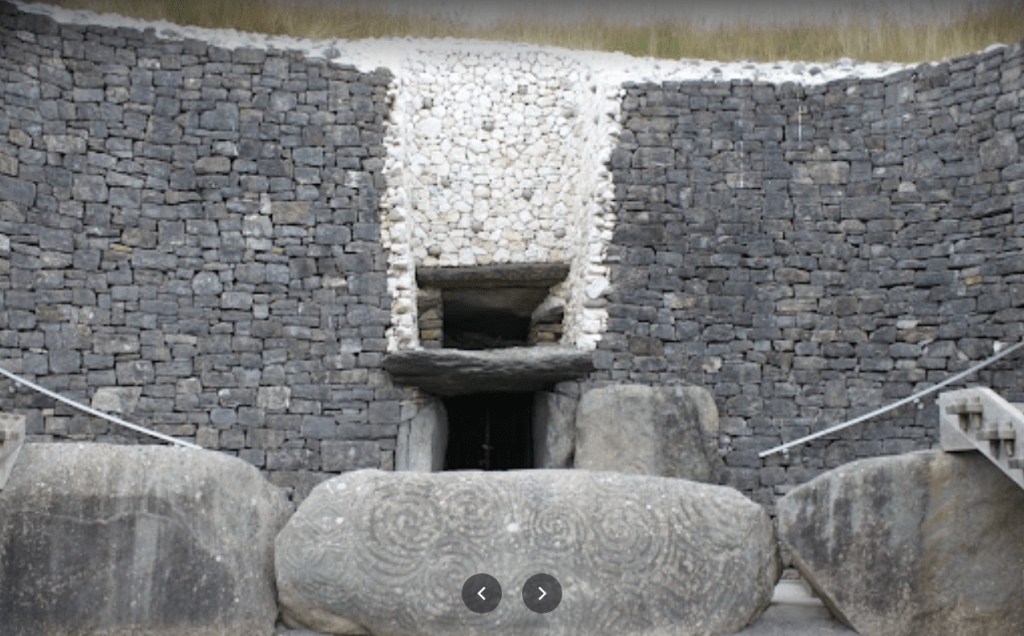
Postscript: Here follow a few photographs from Google Maps of two special places near Netterville Institute, one about a hundred yards from the main house and the other, called New Grange, about five hundred yards away and clearly visible from many of the rooms in the Institute. Both of these national landmarks have been greatly improved since that time when they were both little more than unmarked mounds.
Perhaps more could have been woven into this article about their presence in the area, but if so it would mainly have been to point out that perhaps the vividness of the green, the vibrant density and flavour of the local foods, the strong heavenly presence in the skies and the pagan human realm mischief in so many locals’ eyes and speech are all reflections of the still present spirits of those long-forgotten ancestors even though no obvious signs and feelings remain as ghosts or demons or whatever.
Mount Douth Passage tomb – 100 yards from the main house
Mound Tomb Entrance; a portal into where the spirit of the songs come from?
New Grange mound – 500 yards from main house
New Grange entry passage with large stones, carved spirals
“This book, alone, provides the covered-up facts of 1845-1850 Ireland. There was no famine in the ordinary sense of that word. It was genocide perpetrated by more than half of Britain’s army (67 regiments of its 130 regiments total). They removed, at gunpoint, Ireland’s abundant meats, livestock, and food crops to the ports for export; thus starving the people. The book’s colored map shows the locations of lengthy deployments of each of the sixty-seven regiments while they removed livestock, meats, flour, oatmeal, and other food crops to the ports for export. The same map names the locations of some 180 of the resultant mass graves. The Perfect Holocaust is an achievement of the first magnitude and would be obligatory reading in a free Ireland – Tomás Mac Síomóin, Ph.D.”
.
.
A parting gift. Thankfully, they are still singing in Eire – at least in Derry!
Reading the latest post from Naturalist Weekly whom I follow at https://naturalistweekly.com/2021/11/14/poems-about-the-moon/ I thought I’d take a crack at rhyming verse. Every few lines I had to stop and search around and/or maybe rearrange things but about half came out nicely spontaneous-style.
Am never sure what to make of traditional poetry being much more a fan of spontaneous free verse and especially haiku which is a form directly derived from blending meditation with everyday perception during the long period of widespread Buddhist influence in all the major Asian nations which lasted, more or less, until the decline of the Chinese Empire in the mid 1700’s. They have had several 250 year recessions in their history and are clearly on the rise again, but whether or not Buddhist meditation will enjoy a renaissance in that cultural diaspora remains to be seen. The political classes in China especially are extremely leery of anything religious-leaning because organized religion could morph into organized political resistance to their regimes so they tend to suppress any such movements. Understandable, reasonable but also cowardly and thus wrong. Be all that as it may, the haiku style and its antecedents and derivatives tend to be less sugary and flowery. That said, much of earlier English verse – like Donne, Shakespeare or Milton for example – was far from any such.
In any case, here’s my amateur attempt at rhyming verse which tries to give a flavor, a taste, an incense whiff of Moon. Needless to say, although naturalist blog has some famous exemplars of Moon Poetry, I like mine better!
The picture below is taken from above a somewhat disheveled little mountain village near where we will soon have a small cabin property on a downhill sloping lot with nice valley views similar to this but more immediately constrained and one extremely unusual feature: a small meditation hut built by the most unlikely of previous owners: Theravadin monks in Mexico, who are chilangas, i.e. from Mexico City. Who’d have thunk it?! But then who’d have thunk the now overgrown pyramids from tens of thousands of years ago made by who knows whom. Anything which happened before the last great cataclysm around 10,000 years ago which in Western annals is referred to as ‘the great flood’ is largely unknown to us. Even the Chinese admit they don’t know. Nor do the Egyptians. Buddhist historians from the Dzogchen tradition in Tibet claim that a previous Buddha was teaching around the regions of Ur and Swat in Pakistan-Afghanistan and that about eighteen thousand years ago there was a well developed civilization there one of whose tutelary deities was a red female goddess called Vajrayogini in Sanskrit, making her one of the oldest gods still being practiced today – what is it about sixteen-year old naked women in the full bloom of youth that makes such a lasting impression, we wonders…..
In any case, we intend to stay for a while here in this small-town, tiny mountain village coffee country part of forgotten Mexico where long before recorded history the ancients built pyramids just as they did in pagan Europe long before the Egyptians cottoned on, now similarly overgrown and generally mistaken for natural hills.
We pray the ancestral spirits welcome us along with the Theravadin-built meditation hut – made of stone and plaster – we fully intend to use. As a form of supplication, a haiku is now offered:
.
ancestor shaman brujo bards
still casting spells
as sky-dancing cloud dragons
.
ancestro chamán brujo bardos todavía lanzando hechizos como dragones de nubes que bailan por el cielo
.
Version One (initial version before pruning to the one above):
ancestor bruho-shaman-bards
settled these potent hills and valleys
stillcasting spells as sky-dancing dragon cloud formations
PM: FOR YOU, GABRIEL, what does it mean to be a poet?
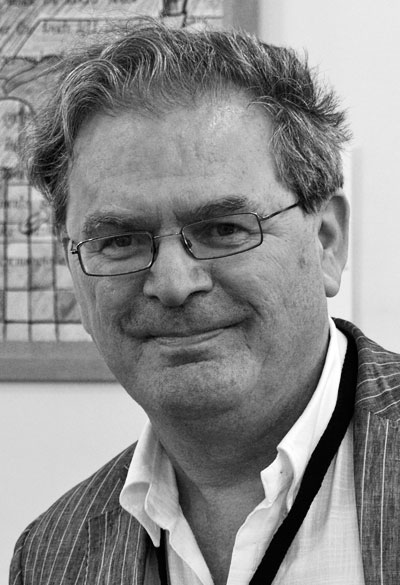
Gabriel Rosenstock: As a poet-translator, I take great delight in transcreating poetry from around the world into Irish (using English as a bridge language much of the time) and one such poet, who writes in Malayalam, is K. Satchidanandan. He answers your question beautifully:
My mother taught me to talk to crows and trees; from my pious father I learnt to communicate with gods and spirits. My insane grandmother taught me to create a parallel world to escape the vile ordinariness of the tiresomely humdrum everyday world; the dead taught me to be one with the soil; the wind taught me to move and shake without ever being seen and the rain trained my voice in a thousand modulations. My beautiful village with its poor people too must have hurt me into poetry …
What it means to be a poet is to give oneself, freely, constantly, to the pain and ecstasy which Satchidanandan describes above, to find new ways of giving yourself, spending yourself, creating and recreating yourself, forging words and forms for the formless immensity within and without, a voice with which to sing the sorrows of existence, a song in search of hope, in search of its own beginnings.
To be a poet is to answer that calling in all weathers. The call of the wild. I am a wild man. My mother used to call me (I was hardly nine at the time), “The Wild Man from Borneo”. The poet is one who cannot be tamed, the bear that you cannot chain, the bird that cannot be caged.
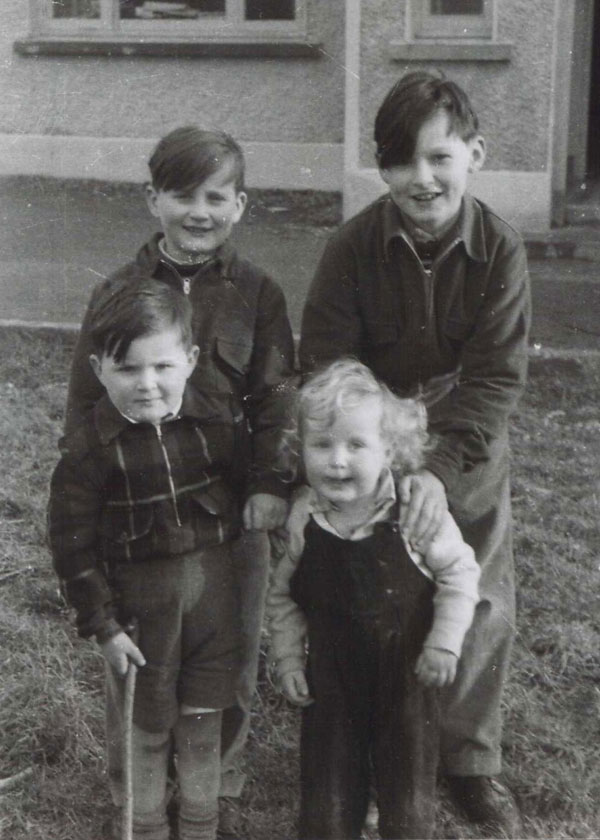
There’s a photo of me as a child with some of my siblings and I’m holding a stick, whether I thought it was a crozier or a shillelagh at the time, I don’t know. The image of the Fighting Irish with a shillelagh is a distorted one—before matters degenerated into faction fighting, I believe the shillelagh was a highly sophisticated tool employed in martial arts.
I digress … the tallest boy in the photo was my brother Michael who was only 17 when he drowned in Glendalough. To be a poet, ideally, is to be Everyman.
Gabriel Rosenstock [with stick] and siblin
………
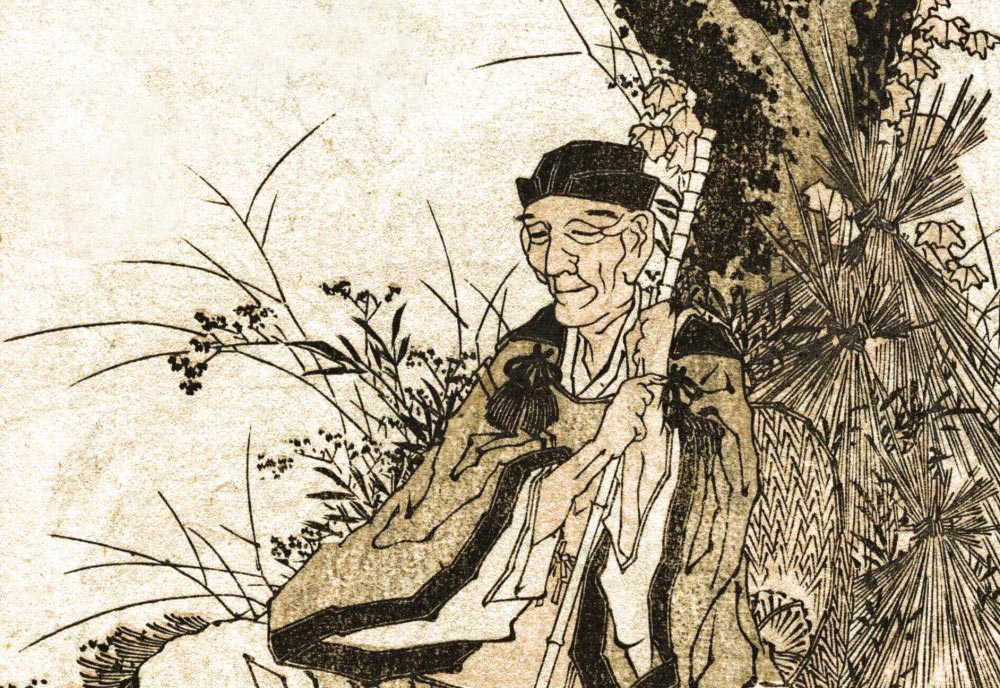
The frivolousness associated with Japanese haiku in Bashō’s time ended when he wrote the following haiku, a haiku surrounded by a great silence:
on a bare branch a crow alights autumn evening —Bashō
I can hear a radiating silence all around this haiku. Can you? It helps that haiku have no title, no full stop at the end: we have entered the haiku, in media res, and it continues without us, into infinity. Where did it come from?
Daisetz Suzuki says that there is a great Beyond in the lonely crow “perching on the dead branch of a tree. All things come out of an unknown abyss of mystery and through every one of them we can have a peep into the abyss …”
I approach haiku with a reverence, even in my irreverent haiku. I have over a dozen unpublished collections of ekphrastic haiku, haiku in response to works of art or photography. If you look at the haiku blogged in response to the work of American master photographer, Ron Rosenstock (no relation), I think you will agree that both the haiku and the landscapes are permeated and perfumed by silence.
Spontaneous haiku are acts of meditation and meditation leads us to Silence and the Self; in other words we can never get in touch with Reality, with Truth, without entering Silence.
dom’ shú isteach sa chroílár ionam féin – grágán
sucking me in
to the deep core of being –
tree stump
Ron Rosentock’s photograph evoked Gabriel Rosenstock’s ekphrastic haiku in Gaelic and English
The following were composed purely as an exercise of trying to stick to the 5-7-5 rule totaling seventeen syllables which had never before attempted. Later I will try a modification which makes more sense to me given the differences in English and Japanese, namely to do a 3-4-3 format with each count referring to a main accented syllable. Example:
Storm clouds loom = 3 main accented syllables.
Stormy clouds looming = 3 main syllables and two minor ones (‘y’ and ‘ing’).
Both lines have three accented syllables, the ‘o’ in storm & stormy, the ‘ou’ in clouds and the ‘oo’ in loom & looming though the first has three syllables and the second five. In English, I find the difference insignificant and so will probably work with the 3-4-3 formulation versus the 5-7-5. And then no doubt not bother overmuch about it and return to my basic 3-line formula loosely configured around Heaven, Earth and Man, the three Daoist treasures of existence-experience.
Meanwhile, I enjoyed trying to constrict myself to the seventeen syllable format even though I’m not sure it works in English the way it works in Japanese.
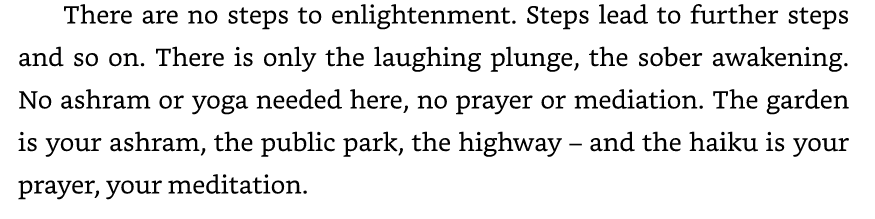
Generally, am greatly enjoying this somewhat intensive exposure to haiku writing though probably will soon taper off publishing so many so quickly. Have done it off and on for decades, albeit usually have indulged in longer compositions, always done spontaneously. There is something more pristine about the three line structure. In Enlightened Haiku, Gabriel Rosenstock is putting forward the notion that haiku is a universal and direct way of transmitting and receiving enlightenment experience. I think he is essentially correct. Haiku are a great gift to us bequeathed from buddhist practitioners over well over a millenia combined with various national characteristics of the gifted Japanese and now many other peoples. If you have some experience with mindfulness and awareness it is quite easy to slip into. You combine some sense of spacious awareness with any sort of arising particularity. The latter can be witnessing something in nature – which is traditional and often the best because nature is natural and uncontrived – but really anything can be the subject-object including a thought or memory. As long as there is some combination of impersonal awareness with spaciousness on the one hand and then some sort of particular event or phenomenon personally experienced on the other. It’s instant yin-yang, emptiness-form, universal-particular.
Neat!
Also, there is an Arts institute here which makes paper, ink and books from scratch, so at some point will have a small run of a book of 108 haiku – some no doubt from these now in the blog – and see if anyone wants to buy such a thing on handmade paper printed with hand-mixed ink. The paper can be made of papyrus or cotton, both grown here in Mexico.
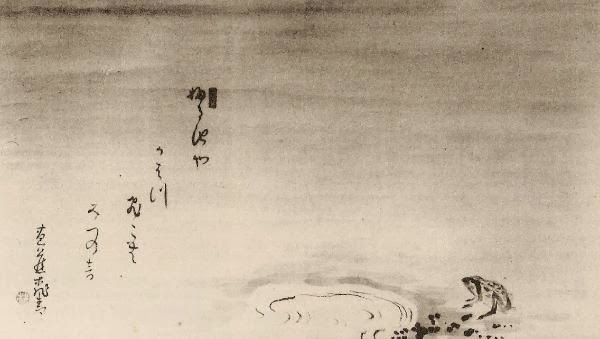
Here follow several versions of the same famous ‘frog jumping into a pond’ haiku, partly for fun and partly to show how different translations create different effects. Haiku is a simple form, but also subtle since it’s some sort of blending, or marriage, of direct perception with non-conceptual awareness-wisdom. Like this particular example, good haiku have an echo, something resonating with our own previous experience. All good haiku do this: basically they create a moment.
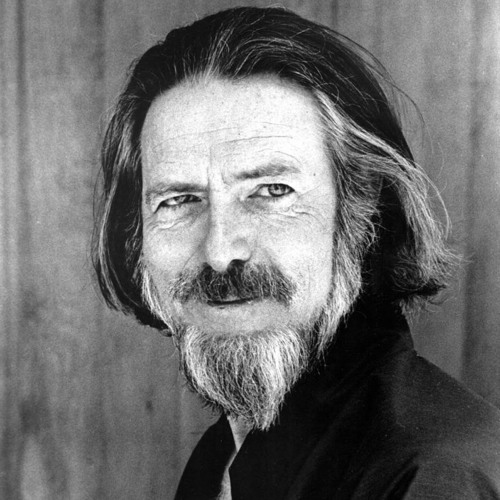
Alan Watts: “The more a thing tends to be permanent, the more it tends to be lifeless.”
Alan Watts
irreverent pirate
plundering foreign fields for wisdom
forever blowing bubbles
#23 07/11/2021
ALAN W. WATTS (1915-1973) was a British author and lecturer whose interpretations of Eastern philosophy—Zen Buddhism in particular, and Indian and Chinese philosophy in general—influenced the beat and hippie generations and helped popularize Zen in the United States. One of the great “gnostic intermediaries” of the 20th century, the New York Times deemed Watts “the foremost Western interpreter of Eastern thought for the modern mind.”
A child of religious conservatives in rural England, and holding both a master’s degree in theology and a doctorate of divinity, Watts became a freewheeling spiritual teacher who challenged Westerners to defy convention and think for themselves. His fascination with the Zen (or Ch’an) tradition began during the 1930s and developed because it embodied the spiritual interwoven with the practical. His work became especially influential amidst the burgeoning youth culture in the 1950s and 60s, introducing readers to THE WAY OF ZEN (1957), one of the first bestselling books on Buddhism, and PSYCHOTHERAPY EAST AND WEST (1961), in which he proposed that Buddhism could be thought of as a form of psychotherapy and not a religion. His writings are noteworthy for their literateness and wit, and according to Erik Davis, “still shimmer with a profound and galvanizing lucidity.”
Though known for his discourses on Zen, he was also influenced by ancient Hindu scriptures, especially Vedanta. He spoke extensively about the nature of the divine reality which people miss: how the contradiction of opposites is the method of life and the means of cosmic and human evolution, how our fundamental Ignorance is rooted in the exclusive nature of mind and ego, how to come in touch with the Field of Consciousness and Light, and other cosmic principles. He was also adept in the composition of haiku, the 17‐syllable poem that is a literary expression of Zen.
His critics—and there were many—deplored some of his interpretations and reproached him for his admitted disinclination to practice any of Zen’s formal disciplines, especially the ascetic ones. He was not abashed, however, describing himself in his autobiography, IN MY OWN WAY (1972), as “a sedentary and contemplative character, an intellectual, a Brahmin, a mystic and also somewhat of a disreputable epicurean who has three wives, seven children and five grandchildren.”
The source of the above biographical blurb
The day before his death, Alan invited my Buddhist master to spend the day with him. I have heard they spent a lovely afternoon together blowing bubbles in the garden and watching them float away until vanishing into emptiness ‘like the imprint of a bird in the sky.’*
43 Minutes well spent…..
.
.
* Chogyam Trungpa, Rinpoche The Sadhana of Mahamudra, 1968
Am reading two books on Haikus (Japanese Death Poems and Gabriel Rosenstock’s Enlightened Haiku). It was raining all day today so I ended up spending a lot of time looking out the window at a large, glistening spider’s web, plants, flowers and my orange trees whilst enjoying Bach and Baroque music and letting little haikus bubble up occasionally to the surface. Retirement can be quite satisfying that way…
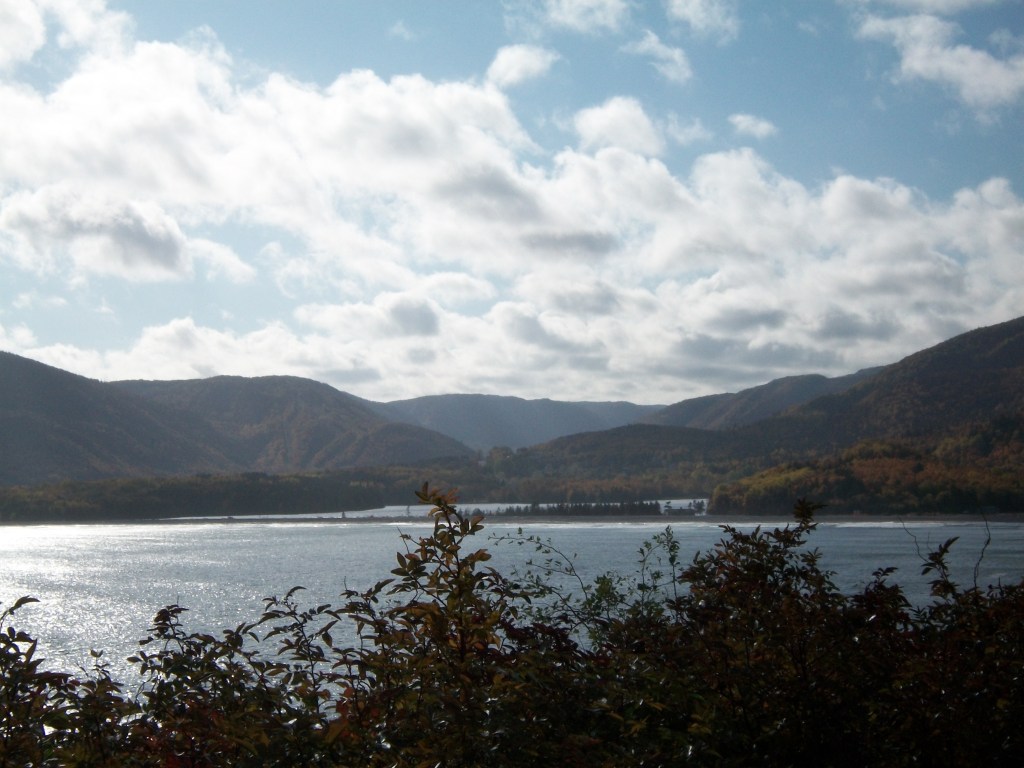
View into Kalapa Valley Ingonish from the Keltic Lodge
November Morning
Still and quiet;
The mountains purple-ish, brooding, naked and powerful in the morning chill. Frost and mist Crowning them, hovering Filled with blessings and mystery.
And you can glimpse through that and see beyond all, above all Bright virgin morning blue Another layer of freshness, of depth, of delight Of sky.
Birdsong Pulsing wingbeat of spiralling sound.
The mist has suddenly disappeared Clouds gather in presence and softness Now surrounded with more pervasive and resplendent blue Radiating oatmealing colours of Golden butter and motherly creams Warmed by the thickening sun of a fresh, throbbing day.
Highland Dawn!
Kalapa Valley Ingonish (where I was blessed to live for a short while)
KOZAN ICHIKYO Died on the twelfth day of the second month, 1360 at the age of seventy-seven.
Empty-handed I entered the world Barefoot I leave it. My coming, my going- Two simple happenings That got entangled.
A few days before his death, Kozan called his pupils together, ordered them to bury him without ceremony, and forbade them to hold services in his memory. He wrote this poem on the morning of his death, laid down his brush, and died sitting upright.
(From Japanese Death Poems compiled by Yoel Hoffman)
Commentary:
First, this blog may well be featuring more of these Death Haiku from time to time. The above one comes from a section dedicated to poems written by Zen monks shortly – sometimes literally minutes – before dying, most of them in haiku form which in Japan involves making them exactly seventeen syllables, the duration of one outbreath.
Linking this with the Three Marks of Existence, we can understand why he told his students and peers to ‘bury him without ceremony’ and so on. It’s because of nowness. Because in nowness there is no past or future therefore there are no beginnings or endings nor therefore any births or deaths. If you insist on birth and death then you must concede that in nowness every moment is birth but equally every moment is death making both notions meaningless.
With all that word salad out of the way let’s get onto the main course which – appropriately for haiku and death poems – is short and sweet. Since there is no birth or death there is no reason to make a fuss about one’s own or anyone else’s death. Just stay present.
You might argue: we can stay present cutting vegetables, cooking them, eating them, shitting them out later (having first walked mindfully to the outhouse) therefore surely also we can stay present whilst attending a funeral ceremony of a loved one?
Of course we can. But the Zen Master – literally with his dying breath – was teaching his students. That’s what great teachers do: every moment of their life is dedicated to holding up a mirror of nowness to the heart-minds of their students. So by not making a fuss when he died they were being taught how to rest in nowness without holding onto anything because holding onto things is how we stray from nowness.
This holding on is referred to in the poem as ‘entangled’ and what entangles them is the word ‘my’ for in life the process of attaching ‘me,’ ‘myself’ or ‘I’ to all experience is what creates suffering in the Three Marks of Existence.
We can never get away from these Three Marks; indeed, they comprise the subject matter of all haikus ever uttered and all teachings relating to wakefulness, awareness, enlightenment and so on – not to mention any truly great Art.
To end, a spontaneously composed haiku. Not a death haiku but a life haiku:
Flower in the crannied wall, I pluck you out of the crannies, I hold you here, root and all, in my hand, Little flower—but if I could understand What you are, root and all, all in all, I should know what God and man is.
Alfred Lord Tennyson
Auguries of Innocence
To see a World in a Grain of Sand And a Heaven in a Wild Flower Hold Infinity in the palm of your hand And Eternity in an hour
William Blake
The Tennyson poem was composed several decades after the one by Blake, but clearly the latter’s first four lines influenced the great Victorian bard.
They are both contemplations along the lines of ‘interdependent origination’ or co-dependent causes and effects reviewed in the previous Buddhism 101 #2 Article though again, the way such notions are usually presented, you might not think it.











 baronbrasdor.art