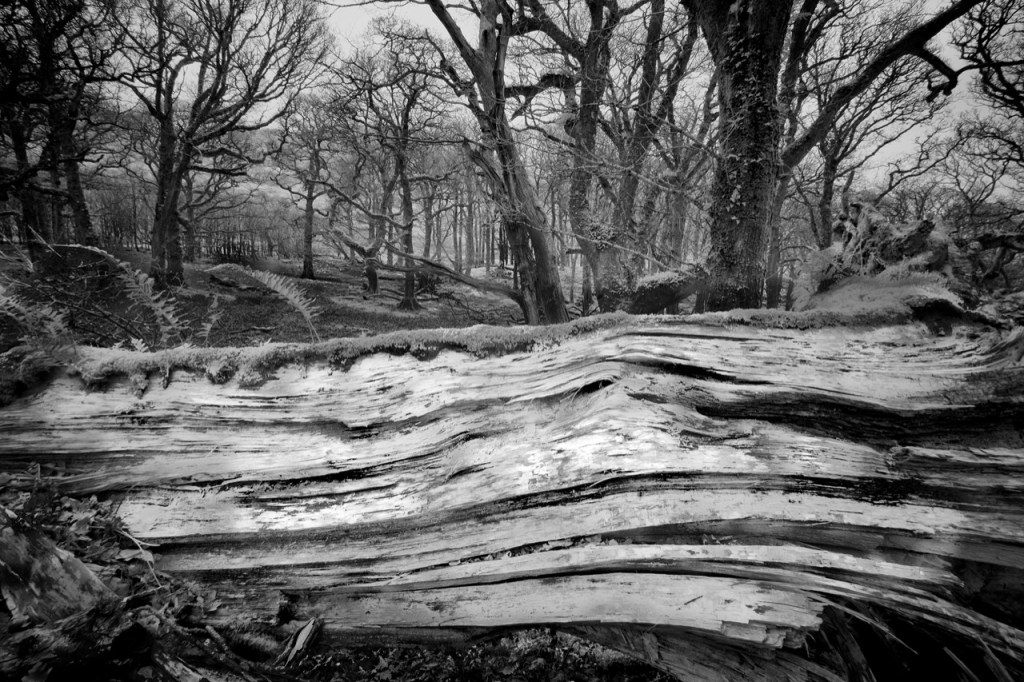
the fallen
lying at the feet
of marching ancestors
Gabriel Rosenstock:
nithe nach bhfeictear
ag breathnú uathu . . . ag éisteacht . . .
Cnoic Shíofra
the unseen
watching . . . listening . . .
Sheeffrey Hills
the fallen
lying at the feet
of marching ancestors
Gabriel Rosenstock:
nithe nach bhfeictear
ag breathnú uathu . . . ag éisteacht . . .
Cnoic Shíofra
the unseen
watching . . . listening . . .
Sheeffrey Hills

sunbeam ambassadors
lightly caressing
feathery faeries…
Gabriel Rosenstock:
ní i dtreo ar leith
a dhíríonn sí . . .
raithneach Chonga
they point
in no particular direction . . .
the ferns of Cong Wood
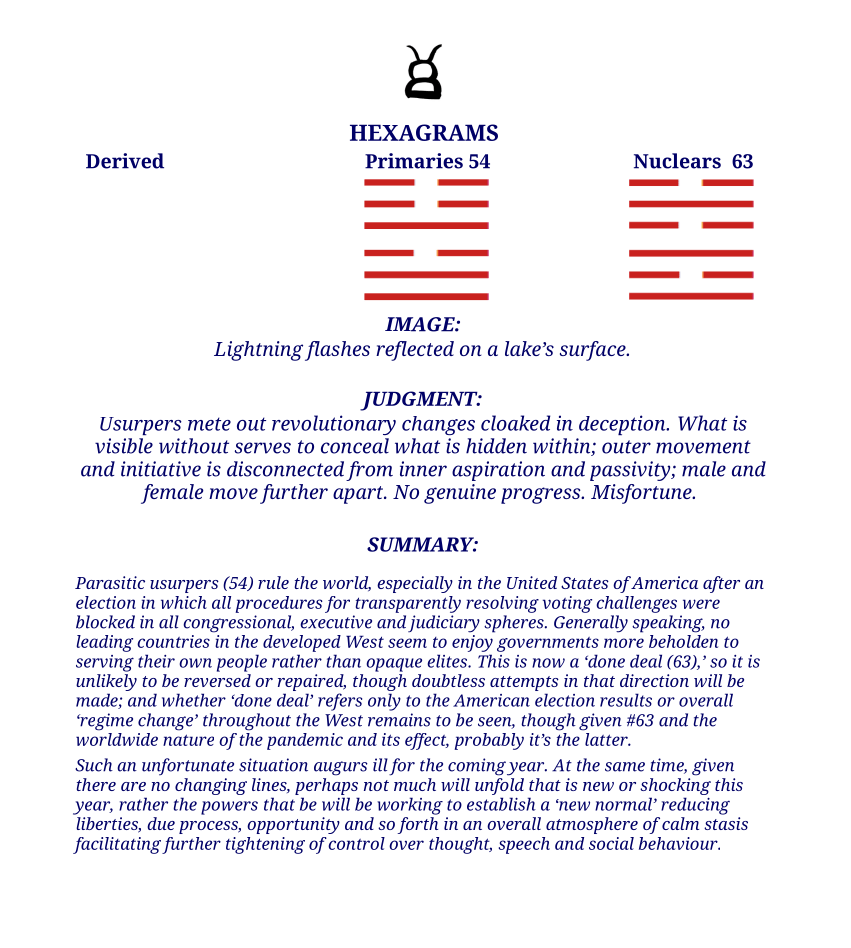
I went back to look at last year’s Yi throw and commentary and thought it interesting in that the Hexagram #54 was echoed in this year’s New Year’s Day Earthquake throw, Number Fifty One changing to Number Fifty Four (51,2 – 54).
The main page is pasted in as an image with the pdf for download down below.

Herein please find attached a pdf file with all the ‘Pandemia Haiku’ written since October 2021. The collection numbers 108 which is auspicious in the Buddhist world.

we stand together
through thick and thin
married at birth
silently honouring unwritten treaties
#111 2022/03/07
In response to a recently published tanka inspired by the above photo by Gabriel Rosenstock who composed it in both Irish and English:
ní bhraitear sa chroí
an draíocht atá i ngach crann
tá an croí sioctha
sa gheimhreadh atá an Úcráin
geimhreadh fada an anamathe magic of trees
Gabriel ROSENSTOCK
is not mirrored in the heart:
it knows only frost
Ukraine is in a winter
the long winter of the soul
https://www.culturematters.org.uk/index.php/arts/poetry/item/3917-frozen
The personal Yi for the Year was 31,6 – 33.
#31 Influence-Telepathy has to do with tuning into others and non-verbal communication, non-conceptual intelligence (also marriage which is on the schedule for this October) whilst #33 Retreat has to do with retreating into solitude, not engaging with negative outer situations. The changing line #6 in the #31 Hexagram indicates that it’s time to reduce use of the mouth including words and speech and rather emphasize non-conceptual realization. So this is what the author will be attempting this upcoming year, hopefully.
The posts that get the most views and likes are – by a factor of 5-10 – the haiku. Haiku involve developing a feel for the non-verbal presence of events and moments so are a good discipline and suit the upcoming gestalt. Therefore, in future this blog will mainly feature haiku and spontaneous poetry with little other more dense, intellectual input. People seem not to find it interesting and I think it would be better to spend less time on trying to explain what ultimately is not explainable and rather just do it quietly and alone.
So thanks to all those who have been liking the haiku and not liking anything else – with a few notable exceptions to whom more thanks. The message has been received and more importantly the oracle has spoken and most importantly it all aligns with the author’s mood these days, so less of the other stuff will be forthcoming.
So let’s close with a spontaneously composed haiku:
chrysanthemums and lollipops
like children playing in the fields
elicit gentle smiles
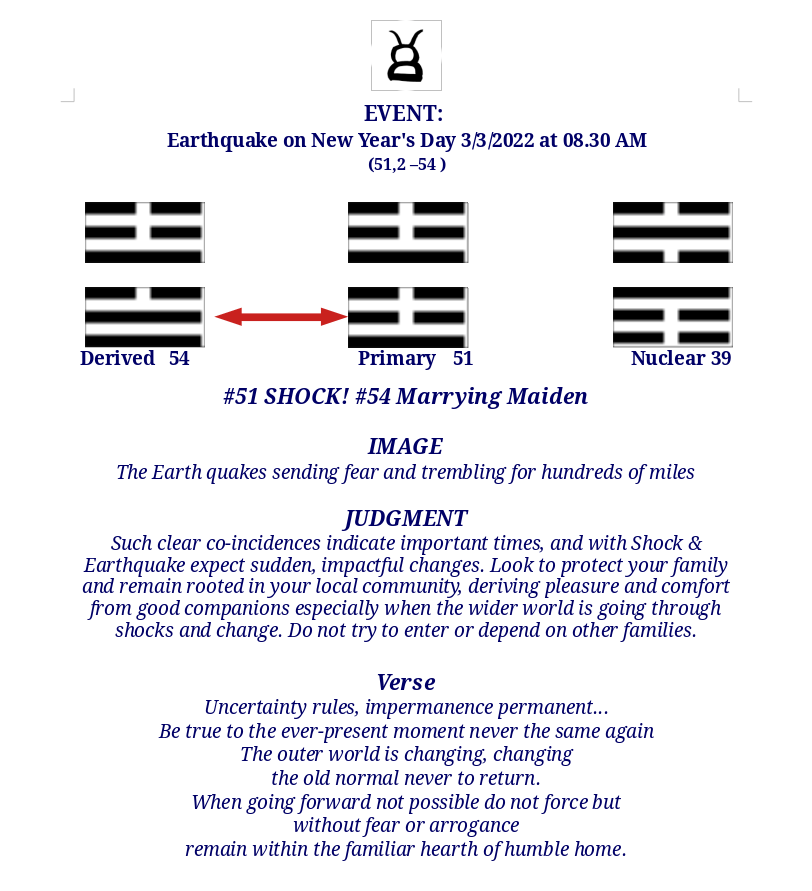
Using a special method that calculates the Hexagrams based on the time of an event produced an almost incredible coincidence: yesterday morning at 08.30, which was the Buddhist New Year’s Day, at our home we felt an earthquake strong enough to shake things around a little but not enough to make any cracks in the walls or anything like that. Enough to get us running out of the house.
I have no idea what the odds are that a method based on time consulting about an earthquake would yield the Hexagram #51 which is about Thunder, Shock. Some texts mention the earth shaking. Basically, it’s the Thunder and Earthquake hexagram. If the event had been more than 30 minutes earlier or later it would not have yielded #51.
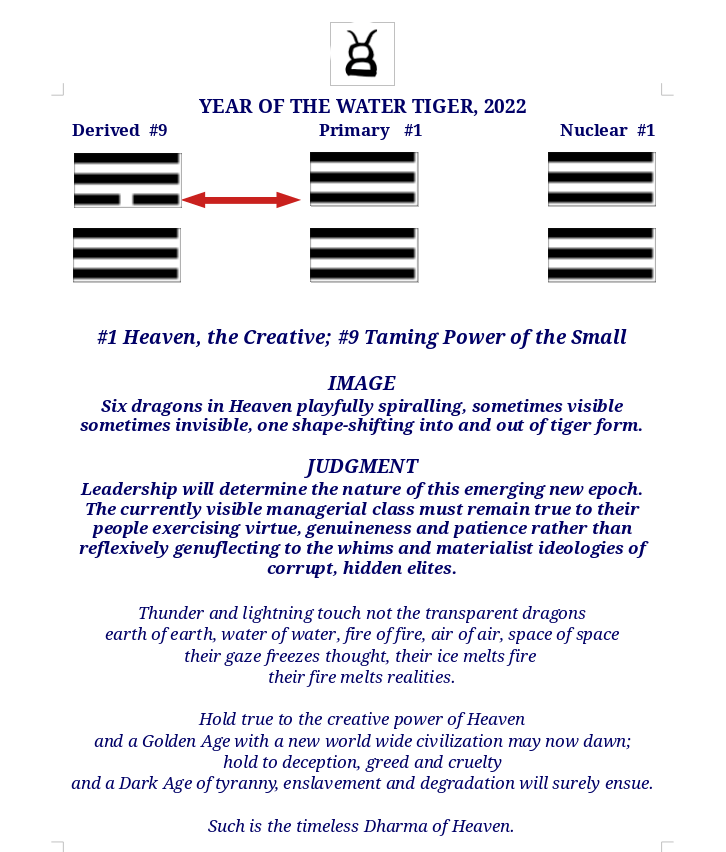
To me, this re-inforces the throw I made later that day up in our cabin property which was the always significant Hexagram #1 Heaven, the Creative which I interpreted to mean that we may be on the verge of a new era in human history, the passing of the old normal and the emergence of something different.
YI TEXT REFERENCES:
THE CREATIVE works sublime success, Furthering through perseverance.(Wilhelm)
The image is six dragons governing the heavens. The symbol is of all-inclusiveness.
(Jou Tsung Wa)
The movement of heaven is full of power. Thus the superior man makes himself strong and untiring.
(Wilhelm)
The Minister’s line of work in progress: A moving Yang line in the fourth place is about taking the lead when you should be following. Trigram Thunder wants to move forward too fast with overwhelming power which only encounters resistance, achieving the opposite of what is desired. Keep the big picture in mind and do not work from self-interest. (Harmen)
“Someone jumping in the abyss. No inauspicious omens.” Who is jumping? Is it man or dragon or both? The ideogram yue shows a foot, a bird, and feathers. This is a shamanistic picture of leaping about and dancing, a ritual to promote creativity. The abyss ideogram, yuan, is fashioned from the symbols for water and vortex, the whirlpool of constant, overwhelming phenomena. The recipient of this line must jump free of the whirlpool of everyday life. (Jing Nuan Wu Yijing)
If you don’t know what course of action to take, you will lose the opportunity. (Jou Tsung Wa Tao of I Ching)
Wavering flight over the depths. No blame. (Wilhelm)
Notes: Xu Shen’s dictionary defines long, “dragon,” as the archetype of all animals that swim or crawl. It is able to be visible or invisible, tiny or huge, short or long. In springtime it can ascend to the heavens; in autumn it lies hidden in the watery abyss. The ideogram follows the pictograph for flesh and a flying form.
(* unbalanced)
Note about Coincidences
Today is traditional Buddhist New Year’s Day. This is the second new moon after the winter solstice. (Actually, that was yesterday but for some reason the scholars-that-be have proclaimed today The Day.)
Am heading up to our cabin property in the hills and will cast the Yi for the year and publish it here later.
No matter what Yi this individual throws, clearly this is a time of great change. Whether it will be for the better or worse largely depends on each and every one of us, how we handle whatever arises. That has always been and always will be true.
In this world of universal impermanence, some things never change!

letting spaciousness naturally settle and expand
any thought being mind made of mind like
waves which are ocean made of ocean…
the short liturgy of vajrakaya
singing my song from below:
may its echoes resound to other realms
undulating goodness
5

empty form, living dawn
breathing, standing, quivering, shining
luminous resplendent!
3
we have heard your speeches
through many ages of men
and remain unmoved, unmoving
ever-changing….
4

mind of ice forms offering
resplendent mind of heaven…
such natural glory of being!
1 – feb 27 2022
we who warmly salute you
melt under your gentle gaze of
magnificently magnanimous equanimity
2 – Feb 27 2022

Heaven…
Earth…
Man…
Glory!!!
#1 – Feb 27 2022
“If you believe there is a thing called mind, it is just a thought. If you believe there is no thing called mind, it’s just another thought. Your natural state, free of any kind of thought is buddhanature.” Tulku Ugyen
Preface: The following is a short piece attempting to express a few things about where we all come from as it were, or the inseparable trinity of dharmakaya sambhogakaya and nirmanakaya. It might also be the basis for a playful non-materialist ‘nature of reality proclamation.’ And perhaps this will become a work in progress….
++++++++++++++++++++++++++++++++++++++++++++++++++++++++++++++++++++++++++++++
All experience involves primordial mind which is more a field, or space, than a thing per se.
Any notion of experience beyond mind, so-called objective reality, is only a hypothetical concept which can never be verified by anyone other than someone with a mind. A reality without mind can be imagined but cannot be verified as such.
Primordial, knowing mind is behind all and every experience so every experience is inseparable from primordial mind.
Confusion is the process whereby we believe that mental events, beings and phenomena are independent from this primordial field even though such confusion is a part of and not apart from it.
Confusion is a made-up contrivance, a fold temporarily concealing writing revealed when the paper is unfolded back to its original state. Put another way: thoughts are mind made of Mind.
All the realms of samsara including all beings and terrains in which they dwell are created by confused minds mistakenly believing that all forms they perceive, including thoughts, are separate from the universal ground of primordial wakefulness, the three kayas of dharmakaya, sambhogakaya and nirmanakaya – or mind, energetic expression and body.
Meditation involves resting in the nature of whatever is happening and allowing the experience to reveal the presence of underlying primordial mind which is not a definable entity with a beginning, middle and end.
Because it is always there, always present beyond past or future and always with a sense of knowing awareness it cannot be said either to exist (since it has no beginning or end or spatial form or boundary) or not to exist (because it is experienced) and the same is true for all beings and realms in which they dwell.
Primordial awareness has three qualities:
– It is clear like a mirror whose surface can reflect no end of forms without being in the slightest effected by any of them.
– It is bright like the sun for awareness is a type of self-existing illumination like bio-luminescence.
– It has a knowing-sentient quality like a wise grandparent or ancestral god, a vast, fathomlessly deep ocean unchanged by though inseparable from any of the endless parade of particular wave actions above.
In a sense, what confusion-samsara does is split the endless variety of particularities on the nirmanakaya surface into seemingly separate, autonomous entities in so doing ignoring that they are inseparable from the all-pervasive, formless continuum of dharmakaya. This splitting is called ‘dualism.’ When the dharmakaya primordial mind nature of reality is being experienced at the same time as nirmanakaya particularities with all their sambhogakaya qualitative displays, this is no longer dualism but rather a liberated, open perception-awareness known as ‘realization.’
When realization develops from being an occasional glimpse to non-stop 24/7 state, this is known as ‘enlightenment.’
So there you go.
This article follows on from an earlier one describing the three kayas, dharmakaya, sambhogakaya and nirmanakaya (One, qualities, Many).

It is said that absolute power corrupts absolutely, so perhaps we should be careful but the saying itself reveals something important: the absolute can be experienced in the here and now and is not merely an abstract principle.
In the Two Truths post it was mentioned how the teachings have a two-way street structure, namely either starting from the fruition (enlightenment) and working back as it were, or starting from confusion and working forward from there. Not mentioned but also of course one can do both at the same time depending on what pops up at any given moment.
But if we are not enlightened already how can we start from that? Because as already explained in the Trikaya post, there are many things going on at once in our experiential continuum, the analogy given being that of how waves which have a seemingly separate and distinct identity as such, each wave being unique and different and in a unique place each time, are nevertheless continuously inseparable from the ocean of what they are a part and not apart from. This is more than just logic; it is truth.
Similarly, in meditation we often experience thoughts. Different traditions have different ways of dealing with them. Simply put there are three main approaches:
This brings to mind the old saying: “first there is a mountain then there is no mountain then there is.” First, a little background from Tricycle Magazine: “During the Tang Dynasty, the Chinese Ch’an [Zen in Japanese] master Qingyuan Weixin famously wrote: “Before I had studied Ch’an for thirty years, I saw mountains as mountains, and rivers as rivers. When I arrived at a more intimate knowledge, I came to the point where I saw that mountains are not mountains, and rivers are not rivers. But now that I have got its very substance, I am at rest. For it’s just that I see mountains once again as mountains, and rivers once again as rivers.” First there is a mountain, then there is no mountain, then there is.”
To unpack this a little: first we see things as we habitually see them in the relative truth world, with waves and ripples and foam and spray all being separate, unique phenomena, and ourselves as well witnessing them, and each moment this happens different from other moments which have happened before or will happen later as we sit on the beach observing such things.
Later though, we might realize that everything we are seeing, being it outer or inner phenomena, is filtered through mind. A fly does not see the table the same way we see the table. Furthermore, we might not see the table the same way our family member does because a table is more than the object alone, it has an emotional context bringing up certain memories and feelings some to do with the past some with the present. For example, to the son it is a place where later on he has to do homework instead of running around outside with his friends; to the wife it is where dinner will soon happen and the family will get together; to the husband it is where he gets to talk to his family all together, the only time that happens every day. And so on.
But it’s more than that: if you go deeper you can learn to see how we have constructed the notion of ‘table’ in order to see it as such. Is the table its legs, or its surface, or the wood pieces its made of or the polish or the stain or the grain or the location or the function? It is none of those things but without any of those particulars it would not be this table. So the table is actually a conceptual overlay bundling all its different constituent parts into a cognitively recognizable whole which we label ‘table.’
“First there is a table then there is no table.”
But this idea that there is ‘no table’ is yet another label because of course there IS a table – it’s right there and we can all see it and sit around it together, clearly. Before we dismiss the whole thing, though, let’s pause to consider: we are not just discussing tables and how we perceive them, but actually our whole world and ourselves and everyone we know in it. Put more directly, this involves how we see ‘I’ and ‘you.’ But let’s stick with just ‘I’ or ‘me.’ Just as with the table, the notion of ‘I’ inside is a cognitive construct. There is no ‘I’ apart from that construct or rather even if there is we are not able to see it unless we drop the habitual cognitive and emotional patterning (aka ‘habits’) we have in observing and experiencing them. We have to see through our habitual cognitive labelling process – ‘no mountain, no table, no ‘I.’
Once we do so, then we can see the mountain, see the table and also see the ‘I’ again albeit now freshly, without the habitual, self-centered cognitive overlays.
The point here is that this can be done. In fact it is happening moment after (illusory) moment all the time anyway. This can be likened to how no matter the drama of the particular, ever-changing displays of wave action on the surface, the ocean underneath remains always and forever essentially the same. Clouds form, move around and then dissolve back into the sky. Clouds and the sky are not two. Waves and the ocean are not two. Mind and thoughts – including the habitual patternings that create the sense of solid ‘I’ and solid others – similarly are not two.
This means that the nature of mind is not apart from the nature of thoughts even if those thoughts give us the deluded sense that they are separate from mind. Perhaps to be clear let us use two different spellings for mind, namely Mind and mind or Big Mind and little mind. Big Mind, or Mind, is the fundamental nature of Mind which is there all the time throughout our waking and sleeping experiences, aka ‘life.’ Little mind, or mind, is the individual thinking mind throwing up thoughts of this, that and the other all the time. Even though the nature of little mind is the same as the nature of Big Mind, it appears to us that they are different because it seems like we are separate, independent, continuous, solid beings apart from and not a part of our surroundings. That is the cognitive construct of the self that we begin to see through when we tune into the underlying nature of those habitual thought patterns and start to directly experience Mind.
As we do so – first with occasional glimpses, later more continuously as those initial glimpses ‘take’ – the seemingly solid projection of me and my mind are seen as not be separate from the overall field, or continuum, of Mind and thus are somewhat transparent. This is exactly the same as when you contemplate waves on the ocean seeing both their unique and particular characteristic whilst at the same time also seeing how they are one with the ocean, they and all their neighbouring waves which are coming and going moment by moment.
First there are waves; then there are no waves; then there are waves.
Once you see the waves as being not different from the ocean, then you can see the waves as they are free from the labelling process. Once you see ‘me and my mind’ as not different from the nature of Mind then you can work with ‘me’ and ‘mine’ without grasping and attachment at which point there is an experience of being free which is called ‘liberation’ in the Buddhist jargon.*
In the terminology of the previous post, Big Mind is Absolute Truth or Absolute Dharma. Dharma means ‘that which is’ or ‘suchness’ or ‘a fact, a truth.’ Big Mind is the dharma, the underlying actual nature, of both Big Mind and little mind, aka ‘my mind’ or ‘your mind.’ This absolute nature doesn’t change no matter what my mind’s thought and feeling patterns are throwing up just like the ocean doesn’t change with different wave actions and the nature of the sky doesn’t change with different cloud formations. Because such natures do not change – mind, ocean, sky – they are absolute in the sense that they are always there throughout any arising, dwelling and ceasing of related phenomena all of which happen transparently within them.
There is no experience in our life without the medium of mind. At first we think of it as the medium of ‘me’ with me being some sort of solid, continuous, separate entity walking around a solid, continuous world with different objects, creatures and locations. But then we realize all such phenomena – objects, creatures and locations – happen within the sphere of experiential mind which itself happens within the sphere of Big Mind. All phenomena take place within the realm of experience and all experience is part of the continuum of Big Mind which can be likened to ocean or sky.
This Big Mind continuum – or ‘field’ in quantum theory language – can be experienced directly. So absolute truth can be experienced directly as the nature of mind. And you can begin with that or rather make that the founding premise of your spiritual path and practice. Or you can deconstruct the relative and habit-maintained constructs engendering our habitual perceptions of self and other so that, by showing they lack the substance and continuity we collectively ascribe to them, we can poke holes in the clouds, so to speak, letting the sky of our underlying nature and the underlying nature of reality show through until at some point those clouds dissolve back into the sky from whence they arose and we see that the nature of phenomena and the nature of mind are not two, are all part of the same overall continuum.
So both paths lead to the same end which is the inseparability of relative and absolute, of waves and ocean, of clouds and sky, of self, other and Mind.
++++++++++++++++++++++++++++++++++++++++++++++++++++++++++++++++++++++
* jargon: 1: the technical terminology or characteristic idiom of a special activity or group (https://www.merriam-webster.com/dictionary/jargon)

 baronbrasdor.art