Buddhism 101 #2 Interdependencies Galore

Contemplating the Nature of Reality

First, let’s get an ‘official’ source:

Francisca Fremantle worked with Chogyam Trungpa, a recently-arrived Tibetan lama in England in the 1960’s, and is one of the better translators, so this is a far more understandable treatment then if we went back to the Encyclopedia cited in the Three Marks of Existence Article. I emboldened the part that specifically links back to the Three Marks. Here goes:

“Interdependent origination (Sanskrit, pratityasamutpada) is the law of causality, which the Buddha discovered at his awakening. It revealed to him the whole truth of existence, and in penetrating it he became the Awakened One. What he saw was a total vision of how and why all beings throughout space and time are entangled in samsara for countless lives, as well as his own past lives in his progress toward liberation. This was the extraordinary insight that distinguished his teaching from others, so it is said, “whoever sees interdependent origination sees the dharma, whoever sees the dharma sees the Buddha.” When Assaji, one of the Buddha’s first disciples, was asked by Shariputra about his master’s teaching, his reply was a summary of interdependent origination, which became famous as the fundamental doctrine of buddhadharma:

Whatever things are cause-produced, the Tathagata has told their cause; and what their cessation is, thus the great ascetic teaches.

According to this law, nothing has independent, permanent, or absolute existence. Everything is part of a limitless web of interconnections and undergoes a continual process of transformation. Every appearance arises from complex causes and conditions, and in turn combines with others to produce countless effects. By interrupting the causal chain at certain key points, the course of existence can be altered and effects prevented by eliminating their causes.”

There are two aspects in this introduction which we are going to ignore in this Article, namely the notion of Samsara and also ‘interrupting the causal chain at certain key points.’ Not because they are not interesting but because they concern Path matters, i.e. a spiritual method or journey. Here, we are just examining the basic notion of interdependency in a direct contemplative way.

There are nine traditional levels of Buddhist practitioner, the second of which is called a Pratekyabuddha or Rhinoceros type Buddha. A Pratekyabuddha tends to live alone and be a very deep meditator with above average insight, so not only has he or she tamed whatever needs to be tamed and able to sustain long periods of quiescence in body and mind but also in so doing they have activated the faculty of vipashana, sometimes translated as ‘insight meditation.’ Watching the endless parade of thoughts and feelings hour after hour, year after year one begins to observe various patterns, styles and qualities rather than being vortexed into any particular content and in so doing develops awareness of what is underneath it all, true penetrating insight into the nature of experiential reality which is the dawning of ultimate wakefulness. The word ‘Buddha’ simply means ‘he who is awake’ though the inference here is that of being spiritually awake not just awake as opposed to asleep in bed as in mundane usage.

It is said about Pratekyabuddhas that they can examine anything and deduce its entire history of causes and conditions, the classic example being that of a bone. So let us take a bone, say a simple femur from a cow carcass that we encounter on a walk through a country field. Let us consider the concomitant causes and conditions that led to this bone being here today in front of us.

Bleached femur in field

At first glance, it’s just an ordinary old bleached bone fragment. But let’s take a closer look into what causes and conditions are right now going into our being able to see this bone. We can also speculate about some previous causes and conditions that went into it having been created some time in the past, though as the Dream Time article has suggested, notions like past, present and future aren’t all they are cracked up to be, helpful as they are in our narrative-based ways of navigating the terrain of ordinary ‘reality.’

Let’s just make a list in no particular order rather than any sort of narrative or argument, a list of all the things that are part of the bone being there in front of us, things without which this event, and this bone, could not exist. It’s actually very simple but rarely do we pause long enough, Pratekyabuddha style, to reflect on all that goes into any single given event or phenomenon. Take a good look at the picture again and now consider:

Earth Plants Soil Bacteria making soil Air Planet Water Sky Earth’s magnetic core rotating around Sun The sun Blades of grass A cow Many generations of cows before her Calcium Minerals Blood Genes Space with galaxies Sentient intelligence Desire of Bulls to mate with cows Complex living organisms Rocks Sunshine Moonlight Cows chewing grasses Cows with five stomachs Entire web of living creatures Man making field on which cow lived and ate Days and years in which bone separated from original carcass and became bleached The country in which this property is determined The millions of people in this country that came before The millions of plants, insects, microbes, days and nights which together created the situation we find ourselves in right now today Myself witnessing this bone My conception, birth, aging up to this present moment The position of the sun right now after millenia of constant motion The infinite causes and conditions involved in each particular blade of grass next to this bone The infinite microbes in the soil busy microbing right now and part of the continual journey of this bone into ultimate dissolving into nothingness one day in the future My eyes All my sense faculties All my organs All my human ancestors All other living creatures And so on and so on ad infinitum.

In this way we can reflect on all the components simultaneously present for any given event or experience to be arising right now. In each case, the number of simultaneous causes essentially is infinite. Not only infinite but in a state of constant flux if for no other reason than the planet is continuously moving so nothing is ever in exactly the same place with the same conditions twice. Ever. Each moment and situation is brand new and different just like each moment the river is different from the moment before. And of course there are no such ‘moments’ really only continuous change involving infinite numbers of ‘codependently’ arising causes and conditions.

Because the number of contributory causes is infinite so also is it impossible to posit any particular thing as having any solid, permanent or truly independent existence. We are all part of a matrix including infinite particularities. In this way the One is many and the many are One, just like all waves on the ocean are unique and ever-changing but equally all are just part of the one ocean. So it is not true to say that they have an independent existence but also it is not true to say that they don’t have particular qualities. So the One has many particularities.

In any case, it’s helpful every once in a while to look around you and consider how much went into it all. I find this especially fun indoors. You can take almost any object or situation and consider where all the materials came from, what was involved in bringing them together, the mining, processing, transportation, work, inherited skills over generations, bringing different elements together and so forth to create things we often take for granted like tables, chairs, walls, refrigerators, propane gas, electricity and smaller things like knives, forks and spoons.

You can do this with a story or literature: all the interdependent associations from past and present that any given word, sentence or speech involves. Shakespeare distills thousands of years of constant post-flood human culture into each and every one of his plays, as do all authors (albeit some better than others!). And you can do it with any thought or experience as well for that matter – with anything.

This sort of contemplation is what is taken for granted in the original definition at the beginning of this Article though most readers will not pick up on it because the authors fail to spell it out clearly – as is so often the case with these traditional presentations. But it’s there in the language if you look; again:

“Everything is part of a limitless web of interconnections and undergoes a continual process of transformation. Every appearance arises from complex causes and conditions, and in turn combines with others to produce countless effects.”

Indeed, hopefully this slightly playful treatment has ‘opened up’ the original text a little. It’s something I like to do to bring these traditional teachings, or insights, into the light of contemporary day. This is usually called ‘commentary’ but I also think of it as translating from one cultural context and time period into another one – our own.

Be that as it may, the infinitely beyond-number swirl of co-dependent originating causes and conditions resembles the infinitely swirling galaxies beyond number each with stars beyond number each with particularities beyond number and on our planet with beings beyond number each with microbiomes and other microbial and subatomic processes beyond number and so on ad infinitum.

We do not exist as independent entities. And yet we do have particular qualities and experiences.

The reason pratekya Buddhas tend to avoid people and spend long hours seemingly doing very little is because they are contemplating the nature of reality 24/7 and paying attention to what is going down around them – which every second of every day is really quite a lot!

Finally, a poet’s playful rendering of some of this material:

Big fleas have little fleas upon their backs to bite them, and little fleas have lesser fleas, and so ad infinitum 

1733 Swift Poems II

Microscopic bugs that live on our skin, perhaps also contemplating the Nature of Reality!

Article 46 Time Dreaming

.

.

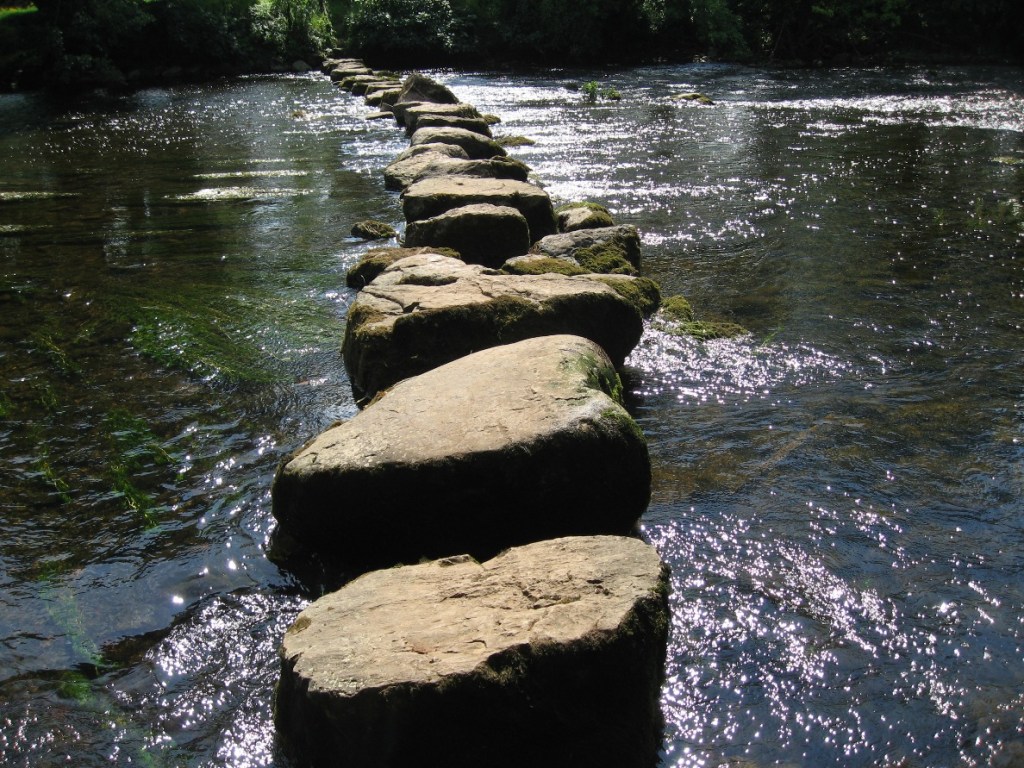
one stepping stone after another

water flowing in between…

both still, both moving

Haiku #12 04/11/21

After the previous Buddhism 101 Article about the Three Marks of Existence, namely Impermanence, Suffering and Insubstantiality, it occurred to me that maybe nothing else needs to be examined or rather this blog need make no attempt to provide some sort of organized introductory course about Buddhadharma. This is because, like all aspects of its teachings, if you penetrate into any single one you get them all. Dharma is holographic that way like everyday reality. In any case, this piece is about Time.

Time is something we experience – or at least deduce. We know that today came after yesterday and tomorrow will come after today. We all know this. Our cognitive faculties create this narrative through which we journey 24/7 our entire lives. But what do we know exactly? For example, even though we experience it every day, does that make Time a thing? You would think so, especially since we can measure it – seemingly – with clocks; but can we touch it, hold it, see it? No. Also, consider that differently configured clocks will measure different units of time.

Time is a construct. Measured clock time is a physical construct derived from various machines or watching planetary movements – like a sun dial’s shadow or the change in position of the sun between sunrise and sunset. Personally experienced time is a subjective experience but not anything tangible.

This can easily be proven in a slightly sneaky way but here goes: take a unit of measured time like one day. Now divide in half = 12 hours and then we keep going: 6 hours = 3 hours = 1.5 hours = 45 mins = 22.5 mins = 11.25 mins = 5.625 mins = 2.8125 = 1.40625 = .703125 = .3515625 = 0.17578125 = 0.087890625 = 0.043945312 = 0.021972656 = 0.010986328 = 0.005493164 …..

Do you see what is happening? Any unit of measurement in time (or distance in space for that matter) is infinitely sub-divisible. You can never find the ultimate particle or moment, the building block of all other particles or moments. Why? Because they are concepts not actual phenomena.

Or looking at it from another angle:

We all experience time in terms of past, present and future. There is the present; before the present was the past; after the present will be the future. But the past and future are, similarly, constructs because they never actually happen; the only time that actually happens is the present. The past happened before the present and the future hasn’t happened yet but neither are actually happening now which is the only time anything happens – seemingly. But as we have seen, there is no definable present moment rather the present is continuously flowing like a river. Something which is continuously flowing is continuously changing which of course is taking us back yet again to the Three Marks, in this case #1, usually called ‘impermanence’ though one can also think of it as ‘continual flux’ or ‘constant flow.’ If there is no single moment per se but only continuous flow then time per se does not exist it is only deduced afterwards by our cognitive narrative faculties. Thus Time is a fiction since only the present occurs but cannot truly be said to exist.

Put another way, the present is the ongoing state of timelessness in which we all dwell. Which is why ‘being in the present’ so often feels ‘timeless’ or ‘primordial.’ Being in the present is stepping out of the construct of past, present and future into timelessness. ‘Being in the moment’ means that you step outside the world of identifiable moments and now swim in the current where all moments are no moments because all moments are continuous without beginning or end.

If there is no beginning or end there is no past or future.

If there is no past or future then there is no present, only ‘nowness’ which is a quality not a thing and earlier in this blog qualities have been described as being akin to ‘the gods.’

And to quote a text called “Learning from Lyme Liturgy” written a few years ago to help get through an intense encounter with chronic illness:

PREAMBLE:

All of us unknown strangers known as ‘me’

We find ourselves in a desert, empty horizon stretched out in all directions;

Here there is no time or place…

A present moment sandwiched between infinitely sub-divisible past and future moments

We cannot find one or measure one: there is no such thing.

Any object or place exists only in relation to other objects and places

All spinning and swirling in space: there is no ‘where’ there.

Without place, no thing, without thing, no place;

A definable object in a definable location,

We cannot find one or measure one: there is no such thing.

As with object and place, self and other are not two:

There is no time, no duration, no place, no thing, no self, no other, no ‘me,’ no ‘you’

Only eternity permeating non-existing past and future moments,

Only infinity accommodating any and all non-existing places,

Only ever-changing feelings: hot to cold, pleasure to pain, love to estrangement and so on.

Truly Impermanence, Insubstantiality and Suffering are

The perpetual and only partners in this great Dance of Life,

This so-called Reality no more than Dream,

This so-called ‘Me’ no more than an imagined projection within that dream,

Our fleeting lives the imprint of a bird in the sky.

As dream-beings, any seeming progress or obstacle such as

Success, failure, praise, blame, loss, gain, pain, pleasure,

Habitual patterns, negative attitudes and conflicting emotions,

Chronic illness pain like fatigue, physical and cognitive impairment and so forth

– or being suddenly sucked down into a nightmare quicksand of insomnia-induced despair –

All such endless journeying through painful hells and pleasurable heavens,

All such appearances being impermanent, insubstantial: how can we be bound to them?

This seemingly solid outer realm, like the living inner dreamscapes we call music,

Neither does nor does not exist, nor does any disease nor its pains, symptoms or pathogens;

No matter what seemingly happens, through living and dying, sickness and health,

Our basic nature, like the Sun behind clouds, remains unchanged.

Or, to make Haiku out of prose:

Time is a fiction

The present moment is a dream

Birth, death and phenomena are illusory

Buddhism 101 #1 The Three Marks of Existence

What is a river?

From a basic Buddhist website using rather stiff, traditional language we can find:

“All saṅkhāras (compounded things) are impermanent”: Sabbe saṅkhāra aniccā

“All saṅkhāras are unsatisfactory”: Sabbe saṅkhāra dukkhā

“All dhammas (all things including the unconditioned) are without self”: Sabbe dhammā anattā[2]

https://encyclopediaofbuddhism.org/wiki/Three_marks_of_existence#Full_expression_in_Pali_texts

Dzongsar Khyentse Rinpoche, a living Tibetan Buddhist master – who happens to make fun films like “The Cup” – translates them thusly:

All compounded things are impermanent

All emotions are painful

All phenomena are without inherent existence

https://encyclopediaofbuddhism.org/wiki/Four_seals

In future, I won’t be going to the traditional languages much in this series but wanted to give the reader a taste to start with since this is often all most people ever read. It’s not that there is anything wrong with the language per se, it’s just rather dry and needs a bit of linguistic prising to open up and reveal itself better.

In any case, let us translate them now as follows:

All outer and inner phenomena are in continuous flux

All sentient experience involves suffering

All phenomena, including any sense of continuous self, are non-existing fictions.

These are three aspects of the same thing viewed from a slightly different angle. We do not need to get complicated. The first one states simply that everything is impermanent because everything that comes together at some point falls apart. But we can get a little more microscopic, or precise: everything is changing all the time and thus has no permanent existence; with a quantum microscope, for example, we can see this on the molecular level. But we don’t need scientific instruments for this: as human beings we can see everything we need on our own level of perception: we know that we are always breathing, our hearts are always pumping and blood is always flowing and thus we are in a constant state of movement, never being exactly the same moment after moment throughout our lives. Further, we all know we begin as infants and end up as wrinkled old senior citizens – if we live that long. At any given moment we are different than any given preceding moment. This we all know to be true. It’s very simple.

Let’s now jump to the last one: any sense of self is false, moreover any sense of anything is false. The classic example made famous by Herman Hesse is that of a river, but again if we have a quantum microscope we can see that even seemingly solid, unmoving objects like large rocks are actually rivers of continuously streaming particles (the infamous ‘quanta’) in constant motion. If you live near a large river then every morning you wake up you know it is there; some days it may be larger or smaller depending on the season and whether or not it rained or snowed last night, but it’s always there. If you go and sit on its bank and contemplate its nature it doesn’t take an Einsteinian IQ to realize that actually ‘river’ is a concept, a label. The actual thing is continuously moving water which is never the same from one moment to the next, not even the same water, nor the exact same currents. And of course this is just as true – in spades – if you are contemplating clouds or the ocean as opposed to a river. And indeed this is true of everything, absolutely everything.

On top of that, we can add in that the sun is always in a different place, the temperature and weather are always different, the position of the Earth in relation to the Sun is never the same twice nor the Sun in relation to our particular galaxy nor our galaxy in relation to others and so on ad infinitum. So this is back to change again, the first one. But that first one implies this third one, namely that nothing that we see or experience that seems to be solid and permanent actually has any solid, permanent or ‘inherent’ existence per se. We can call things ‘rivers’ or ‘trees’ or ‘me’ or ‘you’ or ‘my house’ or ‘my street’ or ‘my country’ but that doesn’t make them solid or permanently real as such.

The second one is what happens every time we try to make things feel solid and real, like ‘me’ or ‘my room’ or ‘my life.’ Because everything is in continuous flux without any inherent existence, trying to make them – including ourselves – feel permanent or solid is a struggle, a fight, an imposition of fiction over reality which automatically causes some sort of stress which we experience as continuous underlying anxiety. This continuous undercurrent of stress, or existential anxiety, is what is most often translated as ‘suffering.’ Basically, it’s going against the flow of reality – which is never the same thing twice – by trying to make things seem permanent, predictable, understandable, solid – aka ‘real.’

In one-word form, these can be called:

Suffering, impermanence and egolessness.

The second two are sort of abstract observations; the first – suffering – is what we feel. It’s the price we pay for being a life form struggling to maintain some sense of continuity and selfhood. We are all like butterflies who, after a long, complex process from egg to larvae to chrysalis to winged marvel live for a very short period of time relatively speaking and then soon vanish forever. It’s all rather splendid and glorious but also evanescent, poignant, painful.

In any case, not long after his Enlightenment experience the Buddha came up with his Four Noble Truths which are similar to the Three Marks in that they cannot be denied or argued away but which focus more on the experiential side of things, the journey of a sentient being through this dreamlike continuum built on the foundation of impermanence and insubstantiality. Or put another way: how to live and not be trapped in existential anxiety, aka ‘suffering.’ For there is a conundrum: if suffering, impermanence and egolessness are inescapable, how can one eliminate suffering, if at all? Answering that question is another topic…

Meanwhile, one final little thought: in many ways the haiku art form is an expression of these three marks: some sort of context is presented and within that context arises a burst of colour, some life, some feeling. And nearly always that feeling, that life, will have an element not just of vivid awareness, but also passion, poignancy, sadness. It’s never too blunt because vivid awareness has an uplifted aspect which can’t be entirely quashed by poignancy, but the combination of brilliance and beauty with impermanence and emptiness is often what makes for the quintessential haiku experience.

(You see, these things do fit together somehow!)

Notes from the Secretary: Upcoming new Buddhism 101 series

Article 45 Notes from the Secretary: Upcoming Buddhism 101 Series

The initial series of Articles were kinda-sorta about mandala, the invisible aspect of what holds things together as identifiable somethings, be they kitchen atmospheres, bodies, countries, plants or national cuisines – basically anything. Then there has been a short Haiku series to which more will doubtless be added over time.

On the subject of haikus, someone who liked one of mine and whom I now follow (www.naturalistweekly.com ) just today recommended: Haiku Enlightenment by Gabriel Rosenstock; Gabriel happens to be a fellow Celtic Buddhist lineage holder – among many other more illustrious accomplishments. The blog page recommending this Haiku book is: https://naturalistweekly.com/2021/11/03/favorite-books-of-2021-and-readers-poll/ . The book is listed at https://bookshop.org/books/haiku-enlightenment-new-expanded-edition/9780985467982 but you can also get the Kindle at amazon.com for $4.51 USD.

At the beginning, this little gem:

The haiku form is short, sharp, and intense

Because it aims to record rare glowing moments

in which our life radiates rays of light.”

Ogiwara Seisensui.

Now begins another series which I am dubbing Buddhism 101 in which a few core principles and teachings will be explained in my short, simple Article format. Generally each piece will be not much more than 1,000 words and will try to keep to a core point and not stray to far from it. Hopefully, they will fit in with the other contributions on this blog, the overall intention being to play with various themes and perspectives; given that it’s the same author doing the playing, they should all fit together on some level. The first in this new series will be about what are called “The Three Marks of Existence.”

There are enough Buddhist texts produced over the past two millenia, especially after the Chinese invented bulk printing in order to disseminate them widely throughout their civilization long before Gutenberg got busy to fill any large Western library or museum many times over. The tradition has never been centralized, however there are many core principles and teachings that are widely accepted. That said, how they are explained is largely a matter of style and circumstance. Most of the original Pali texts, which came from formats designed to be memorized and passed on verbally and therefore which feature no end of repetition as one new point reviews the previous ones before placing itself at the end of the recitation, are ponderous and stiff to the modern English-speaking ear. Shakespeare has encouraged us to expect a bit more oomph and zip in our expressions, as his influence in the surprisingly colourful King James Bible so vividly attests. In that spirit, I thought it might be fun – as well as informative for some – to go over some core Buddhist concepts in a simple, direct and sometimes informal way. Whether or not this is what happens remains to be seen.

One formal definition of being a Buddhist is that you take Refuge in the Three Jewels, about which more later. Another definition is that you agree with these Three Marks; if you don’t agree, then you cannot consider yourself a Buddhist. Presumably few reading this blog could care less about whether they are, or are not, Buddhists, but you might find the Three Marks interesting to contemplate nevertheless. They are the foundation of an approach – called The Middle Way – which dominated the worlds leading civilizations in Asia for well over a millenia.

Haiku #11 Fresh Sunny Day

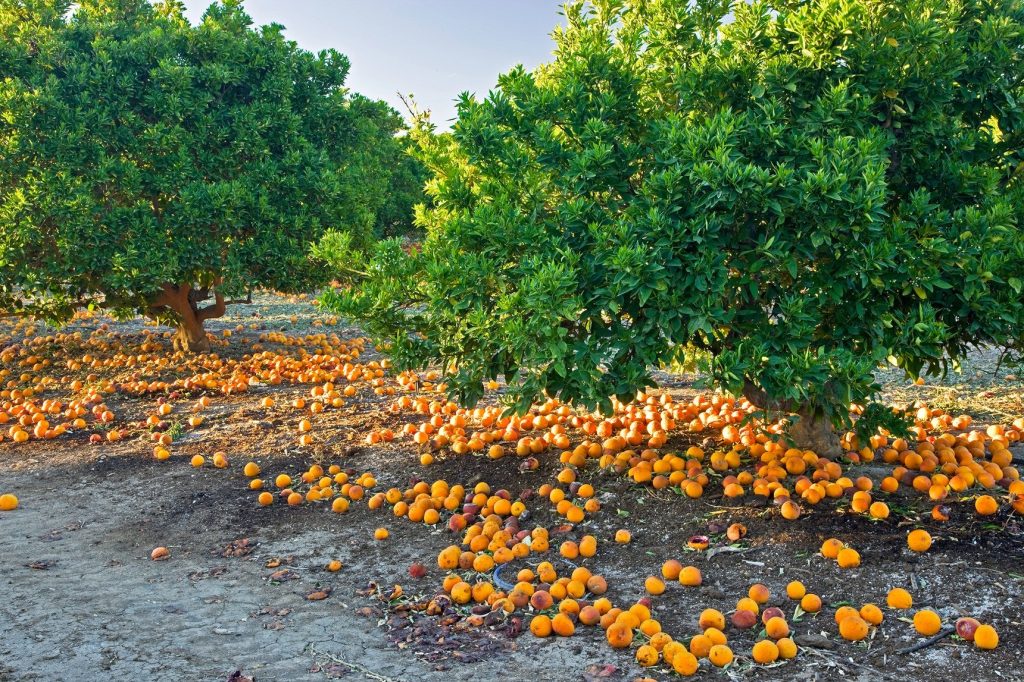
Oranges under their trees

.

.

A string bag of rotting oranges at the base of a tree

The insects are rejoicing

Another beautiful fresh clean sunny day!

.

.

Una bolsa de hilo de naranjas podridas en la base de un árbol

Los insectos se regocijan

¡Otro hermoso día fresco, limpio y soleado!

#11 11/01/21

Haiku #10 Empty Form

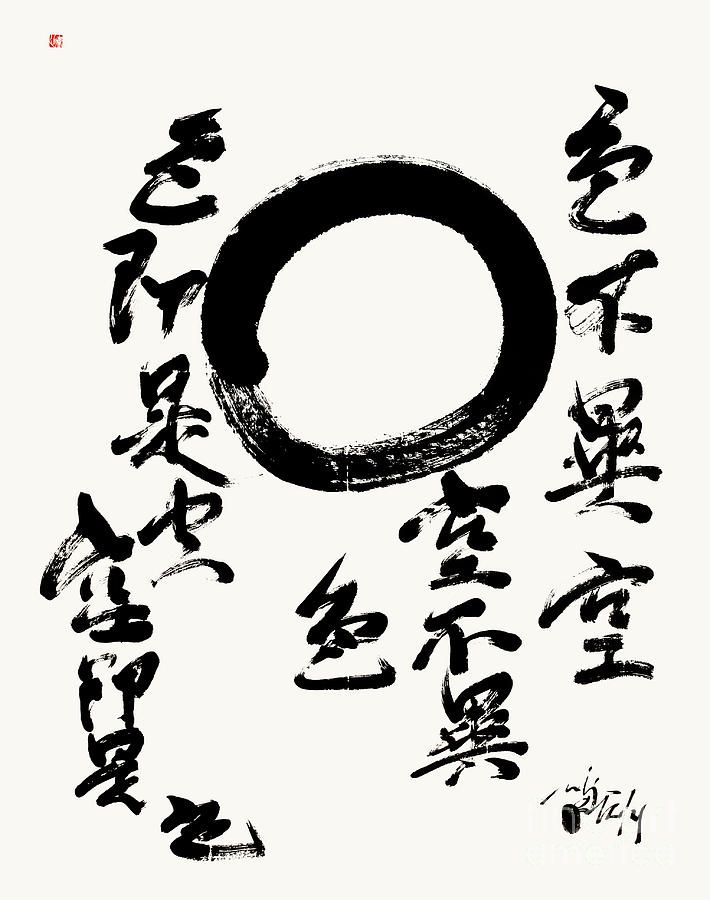
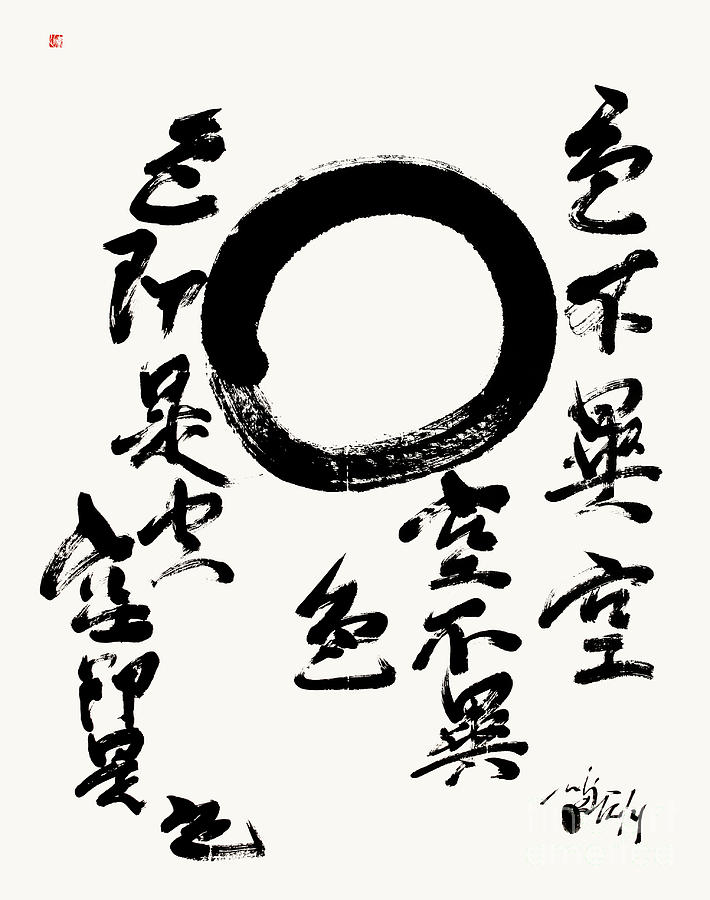
Form is emptiness, emptiness is form

.

.

Black ink form suddenly emergent

Creates space out of that white which is not the form

Turning nothing into a something which is still not anything yet vivid

.

.

La forma de tinta negra emerge repentinamente

Crea espacio a partir de ese blanco que no es la forma

Convertir nada en algo que todavía no es nada vivo

#8 10/31/21

Article 44 A realm beyond words

A true Artist and tough Working Man

Not everything has a name. Some things lead us into a realm beyond words.” Aleksandr Solzhenitsyn. (1918-2008)

The following is the Introduction to ALEXANDER SOLZHENITSYN’S Warning to the West, Speeches, 1975-6 given whilst he was an exile from his homeland and living in Montpelier Vermont. He returned to Russia soon after the collapse of the Communist regime in 1990 and died in 2008 near Moscow. (You can find this book online if you know where to look!)

Speeches to the Americans

JUNE 30, 1975 INTRODUCTION BY GEORGE MEANY (President of the AFL-CIO Union)

When we think of the historic struggles and conflicts of this century, we naturally think of famous leaders: men who governed nations, commanded armies, and inspired movements in the defense of liberty, or in the service of ideologies which have obliterated liberty.

Yet today, in this grave hour in human history, when the forces arrayed against the free spirit of man are more powerful, more brutal, and more lethal than ever before, the single figure who has raised highest the flame of liberty heads no state, commands no army, and leads no movement that our eyes can see.

But there is a movement—a hidden movement of human beings who have no offices and no headquarters, who are not represented in the great halls where nations meet, who every day risk or suffer more for the right to speak, to think, and to be themselves than any of us here are likely to risk in our entire lifetime.

Where are the members of this invisible movement? As we prepare tonight to honor the presence of one of them among us, let us give some thought to the rest: to the millions who are trapped in Soviet slave-labor camps; to the countless thousands drugged and strait-jacketed in so-called insane asylums; to the multitudes of voiceless workers who slave in the factories of the commissars; to all those who strain for bits and pieces of truth through the jammed frequencies of forbidden broadcasts, and who record and pass outlawed thoughts from hand to hand in the shadows of tyranny.

But if they remain invisible to us, we can hear them now, for there has come forth from under the rubble of oppression a voice that demands to be heard, a voice that will not be denied.

We heed this voice, not because it speaks for the left or the right or for any faction, but because it hurls truth and courage into the teeth of total power when it would be so much easier and more comfortable to submit and to embrace the lies by which that power lives.

What is the strength of this voice? How has it broken through to us when others have been stilled? Its strength is art.

Alexander Solzhenitsyn is not a crusader. He is not a politician. He is not a general. He is an artist.

Solzhenitsyn’s art illuminates the truth. It is, in a sense, subversive: subversive of hypocrisy, subversive of delusion, subversive of the Big Lie.

No man in modern times and very few in all of history have demonstrated as drastically as Alexander Solzhenitsyn the power of the pen coupled with the courage to free men’s minds.

We need that power desperately today. We need it to teach the new and the forgetful generations in our midst what it means not to be free. Freedom is not an abstraction abstraction; neither is the absence of freedom. Solzhenitsyn has helped us to see that, thanks to his art and his courage.

His art is a unique gift. It cannot be transmitted to another. But let us pray that his courage is contagious.

We need echoes of his voice. We need to hear the echoes in the White House. We need to hear the echoes in the Congress and in the State Department and in the universities and in the media, and if you please, Mr. Ambassador Patrick Moynihan, in the United Nations.

The American trade-union movement, from its beginnings to the present, has been dedicated to the firm, unyielding belief in freedom. Freedom for all mankind, as well as for ourselves. It is in that spirit that we are honored to present Alexander Solzhenitsyn.

Let us end with another quote by the Great Artist:

“Socialism of any type leads to a total destruction of the human spirit, and to a leveling of mankind into death.”

In short: we have been warned.

Relevant recent article: https://www.americanthinker.com/articles/2021/11/has_american_become_a_realm_beyond_words.html

A spontaneously composed poem is…

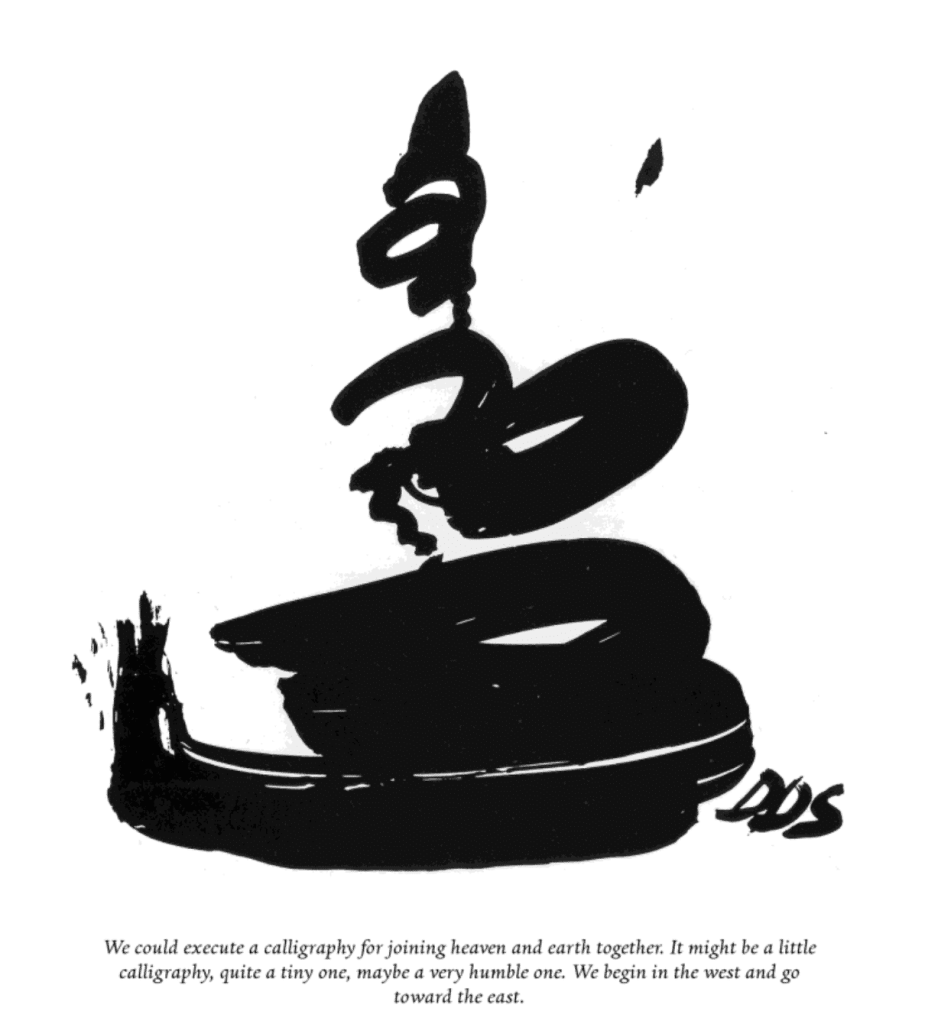
Calligraphy spontaneously composed by Chogyam Trungpa, a Tibetan Buddhist master

Spontaneous poem is like

Brushstroke journey

One moment following into the next

black ink on white paper

shape out of the formless

punctuation for the sheer hell of it

Even a pause is continuation of the flowering

Even silence speaks….

And then off we go again

Sometimes soaring into rarified alpine airs

leaping peak to peak like proverbial Tibetan snow lion

sometimes plunging into fetid valley

padding on pulpous paws through rotting underbrush

sniffing for putrid carcasses of much-loved meals

senses alert, stripes incandescent

with immanent appetite

and hot fresh blood smell of the

next hot fresh kill.

And then we swoop away again and from smooth lines we

occasionally

SLASH DOWN VIOLENTLY

or even back track

or scribble violently from side to side

from side to side again and again

going over the same side to side slashing

with slight variation in angle maybe

or maybe not and then

we can move to circling round and round

perhaps expanding

then contracting

smooth neat lines overplaying their precious simplicity

until repetition births complexity

smoothness becomes rough

clarity gets messy

and it’s like we are in gritty back alleys

in a large city

a couple of homeless sleeping near a large restaurant dumpster

and undying shiny wrapper garbage

the only signs of life

in such dark, street-lit dark alley undergrounds

(you never know where you might end up!)

Then on we go with a brave long stroke into

new vistas of fresh white paper

stroking soft

stroking smooth

rejoicing in bright clean freedom once again

like well-trimmed sloop cresting the waves

and beating forward into resplendent challenge

of salt spray wonder

and adventures

as yet unimagined

yet now glistening on the upthrust, rainbow sporting

prow.

Haiku #6 Van Gogh’s Blessings

After pasting in the Cornfields painting for Haiku #5 by once-pastor to impoverished mining community Van Gogh, and who inspired one of the characters in Emile Zola’s famous work ‘Germinal’ and who later died a patient suffering from mental illness induced by a lifetime of outer world hardships and failures, the following haiku arose, imagining what Van Gogh might have written to us all and perhaps had displayed beneath the cornfields painting in an exhibition in Paris – something which in real life he never got to enjoy.

Van Gogh’s last painting: Cornfield with Crows

“Man with feet of clay mired in mud of misery

Artist sliced by ecstatic shards of Divine Vision

May my many losses be your blessings”

Haiku: #5 The Times

Van Gogh’s last painting: Cornfield with Crows

He: scuffing a forlorn boot on wasteland gravel

She: waiting by the river for Lothlorien Prince

We: waiting for hope to prove worthy not traitorous

(After pasting in the above cornfields painting for this haiku on a whim, another arose now published as #6.)