About two books which tell about the grand voyages of 1421 and 1434
First, a comment I left on the Moon of Alabama yesterday. (Forgive any sloppy writing.)
========================================
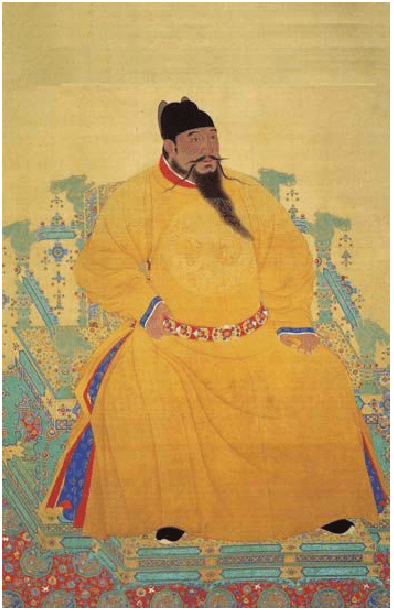
Update on Admiral He story.
First, I highly recommend Menzies’ books. Have read most of the first one and peeked into the second. The first is about the 1421 voyage (which involved several coordinated fleets worldwide in order to both map the world definitively once they got their longitude methods down which happened in the early 1400s, and also to extend their tribute territory if possible.)
Disregarding the inevitable controversy when new narratives are introduced, I’ll just summarize the overall narrative arc for those who might find it interesting:
1. The fleet did map most of the world including North and South Poles. Settlements up and down the Pacific Coast of Americas from Vancouver Island to Chile, which had many horses already when the Spanish arrived, just as California had rice etc etc. (lots of info in the book). (Also East Coast and inland. Many native tribes could understand Chinese in the 1600’s etc.) Also Mayans in the Yucatan.
2. A decimated fleet returned to China only to find that their entire enterprise was to be ‘cancelled’ by the Mandarin class.
3. Background: Yung Lo’s father the previous Emperor had been involved in expelling the Mongols from China (Yuan dynasty). He did so by restoring the Mandarins who had been suppressed. But the Mandarins had their own problems. They were narrow minded, insular, hereditary aristocracy class, hidebound etc. So the new Emperor – who was known as ‘the usurper’- used alliances with high-ranking Eunuchs to balance his power against the Mandarin block because he felt strongly that China should be expanding. Hence the fleets. There were many over a decade or more. Huge expenditures. He also built the Forbidden City palaces. And much more. A very dynamic ruler. But increasingly resented by the Deep State mandarins.
When the fleet left, soon after there was a historic Tsunami which got rid of a significant number. Around the same time lightning struck the new Palaces in Beijing and a fire burned most of his concubines to cinders. Then he became impotent. And then he had to fend off resurgent Mongols in the North and lost. And died.
So when Admiral He et alia returned, battered, bruised, decimated but victorious, Yung Lo’s vision was into the Cancel Bin.
4. The next Emperor reversed Yung Lo’s elevations of Eunuchs to run the navy and trade missions and marginalization of the Mandarins. But he only lasted 3 years.
5. The next Emperor was Yung Lo’s grandson. He triangulated. He went forward with the outreach and sent a large fleet, under Admiral He again, to Cairo – which had been trading with CHina for over 600 years regularly at that point – and Italy. That is the subject of the second book, 1434 about which there is quite a bit of documentation though you won’t find it in the history books. The Mandarins cancelled all that too.
6. Because at some point the Chinese closed up.
7. The Portuguese, many of whom had been on board with Admiral He during his round the world passage, got hold of the maps with accurate longitude and latitude. (Columbus had a smuggle copy when he went to the Americas which he did NOT discover, it’s a complete lie – there were many Portuguese settlements with forts and churches by the time he got there because they got the Chinese maps first and they had been going even before the 1421 Chinese (and so had the Chinese though they didn’t have the ability to make accurate maps until the 1420s).
8. Because of the Chinese Empire pulling back, and because of the Italians (the Pope) refusing to play ball with the Chinese Empire following the 1834 trade mission (during which they shared their star maps, navigation technology and many other things, some of which later surfaced as Leonardo da Vinci ‘inventions’), once the Chinese retired to their borders, it was the Christians who took advantage and gradually encroached on the trading routes established for centuries using force and guile but mainly taking advantage of the gap left by the stupid Mandarins and their over conservative approach.
In short, the rise of the West was [largely] due to the internecine conflict within Imperial China triggered by the Mongol takeover and after math. China’s civilizational arc was interrupted once the Mandarins took back power and turned the Empire inwards.
It is now on the rise again.
About the SMO: Quite possibly Putin et alia and Xi are aware of this history and have discussed it. Admiral Menzie’s books created a stir in China and many historical societies there endorsed his thesis. So quite possibly the aims of the SMO are to reverse the course took in the 1400s which allowed the Chritian-Western-One-God-materialists of the West to run roughshod over a great civilizational diaspora including Daoist, Buddhist, Islamic, Jewish (called Kamirs in Egypt, fabulously wealthy with huge palaces in China from their trade income there for hundreds of years) and Christian peoples. It is time to reverse the plunder ethic and replace it with the old one large multi-civilization civilization ethic.
So the SMO might very well be designed to exhaust the West to the point it can no longer force project in the Eurasian space any more. At which point they can continue their Belt and Road civilizational initiative which would have transpired back in the 1400s had not those Mandarins hated the eunuchs and mongols so much and turned their backs on the rest of the world. A mistake they are not going to make this time around.
That said: the palace DID get hit by lightning; the biggest fleet ever WAS almost entirely sunk by a huge tsunami. The Emperor WAS defeated in battle. Hardly surprising they took this as an omen to withdraw.
In any case, that happened. And now the story continues.
I always have wondered what spurred the Western rise given Asian dominance for so long. Turns out it was a self-inflicted wound leaving a gap that the Westerners – thanks to Chinese technology freely given in the early 1400’s – exploited.
Truth really is stranger than fiction, eh?
======================
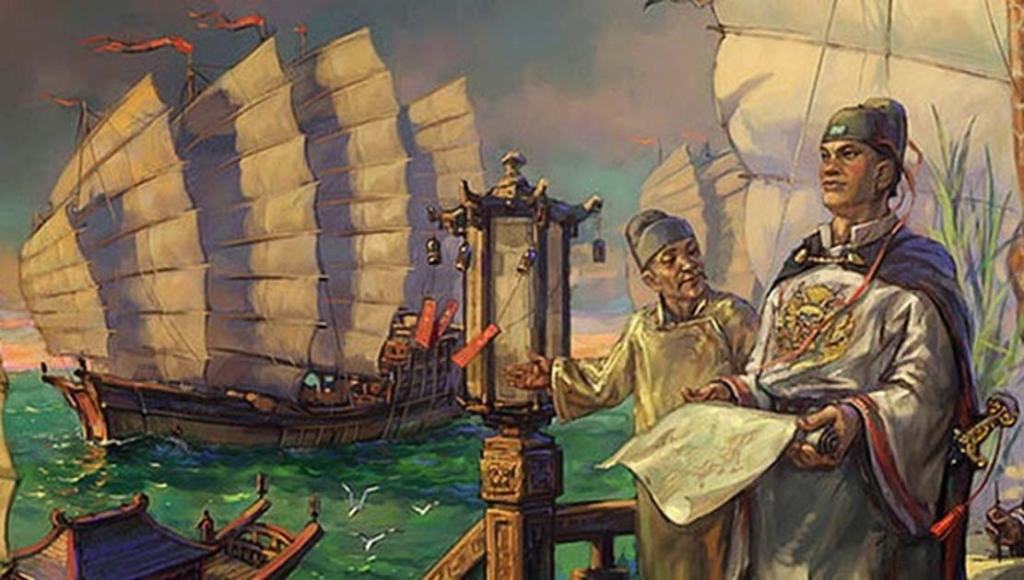
Footnote: in the second book, after many additional inputs from experts the world over following the first book, it is clearly explained how they could calculate longitude on board, accurate to within about 50 miles sometimes much less. This capability is why the fleet was sent forth to cover the globe because they had finally figured out how to do this without needing the eclipse method. So they indeed set out after years of building up a fleet of over 1,000 ships, then they mapped the entire world including Antarctica, these maps were later copied and used by the Portuguese, then the Spanish, to conquer the Americas and East Indies etc. and the rest, as they say, is history.
Posted by: Scorpion | Jun 8 2023 6:52 utc | 185 [linked]
=====================
Additional remarks:
The Books:
Menzies: 1421: The Year China discovered America
Menzies: 1434: The Year a Magnificent Chinese fleet sailed to Italy and ignited the Rennaissance.
I have read most of the first one (need to go back to read the first half slowly which mainly skimmed) and only the introduction of the second book. No doubt he makes some mistakes – he is after all peering back six hundred years – but after the first edition came out and he received feedback and new information from all over the world in response, it turns out that he was erring on the side of caution. The fleet was more than double his initial conservative estimate, they went further than he initially reported, much of which is updated in a Postscript to the second edition. He visited various historical societies in China who not only endorsed his views but added to them.
More importantly, I believe it important to leave the controversial aspects – with all attendant arguments – aside and just examine what is proposed, which is interesting in itself. If we accept as fact that these large fleets did traverse the world in the 1420-22 period in order to map it thanks to their recently developed ability to calculate longitude whilst under sail (several hundred years before Westerners could do it), and we accept that they did indeed map most of the world (including North Pole region and Antarctica) and that many Portuguese navigators – some of whom were on board Admiral He’s ships during these historic voyages – later got hold of those maps (such as Piri Reis and others) and these maps were then used by Westerners to push their maritime envelopes, that is something worth pondering.
But then we have the other side of it which is that for internal domestic political reasons the Chinese Empire decided to turn inward for a few centuries, a period which has now recently ended with China now proactively pushing its Belt and Road Initiative which essentially continues what Admiral He and his Emperor, Yung Lo (whom the hostile Deep State mandarins labelled ‘the Usurper’) started (following the Great Khan’s lead a century or so earlier). In the second book about the trip to Italy, Menzies tells how trade with Cairo and the Middle East had been active, stable and with high volumes for over six hundred years before 1434, but that after China pulled in its horns, that trade ended. This created a geopolitical, cultural and maritime trade gap which the emerging Europeans, following the Chinese example in the 1420s and 1430s, could aspire to and then actually did exploit. It wasn’t so much their expansiveness as China’s reclusiveness which gave the West its momentum. Their were Jesuits and others in the Chinese Courts well aware of the new posture and no doubt they informed their masters in Christendom of these epoch-shaping opportunity. (The power of good Intelligence!)
And here we are after five hundred years of relative Western dominance with the worm finally turning back to where it was for most of post-flood history, namely with a large civilization in Asia playing a key role in world culture. Personally I hope that the West wakes up, cleans house and joins in the Belt and Road vision which is not new but only rarely comes on offer. The Russian Tzar Nicolas I was all over it. Charlemagne was into it too though with less idea of the rest of the world at that point. The Chinese were into it after Genghis Khan created a pacified Central Eurasia all the way from Hungary’s borders to Beijing.
Anyway, the arc of history curves slowly but steadily and we are now living in a time when Admiral He’s exploits six hundred years ago are, after a long hiatus and many twists and turns, finally bearing fruit. I have reservations about the level of wisdom and high culture in China these days so wonder if they are up to midwifing a new world wide civilization – especially given how unstable and aggressive many of the other Powers in the world are these days, especially of course the Western bloc – but I for one wish them the best as well as, again, hoping we in the West actually join in. In that way, a new Golden Age could indeed dawn.
Footnote: along with trying to establish Admiral He’s voyages Menzies uncovered something far greater in many ways, namely the long-term influence of Asia on the the Americas, now corroborated by genetic studies. Indeed, when the European colonialists starting coming in during the 1500s they encountered Chinese settlements and/or Chinese influence all over the place throughout North and South America many of whose tribes (including the Cherokee for example) were able to understand Chinese centuries later. This seems to have been scrubbed out of our collective knowledge base. Cancel culture is not a new thing, we just never saw it en masse on social media before, that’s all. Similarly in China, all records of the Treasure Ships fleets was erased from their history by the Mandarins.
When Columbus came to the Caribbean he had maps – via some Portuguese via the Chinese after these historical world-mapping passages. Original notes show that the early explorers encountered many Portuguese settlements long in place. Indeed, some of the Portuguese had been visiting North America since the 1300s, before Admiral He’s fleets. They were in a good place latitude-wise to do so after all; they couldn’t yet dare to sail the world oceans but they could sail back and forth in the Atlantic. They couldn’t chart accurately where they went (Columbus often got his locations wrong by more than 1500 miles because of the lack of accurate longitude calculations) but by holding latitude they could hit one continent or another and then make their way to a desired port away or at home.
So another aspect to this tale revealed by Menzies is the significant effect that cancel culture can have in world affairs. The presence of Chinese in Mexico, which apparently is significant in many zones, not just coastal, is unknown by today’s Mexicans probably because it has been deliberately suppressed by the Roman Catholic church who also presumably suppressed knowledge about the great Chinese fleets and their visit to Italy after they no longer sailed the Asian oceans from Taiwan to Cairo and all in between once China turned its back on the world. (Making the current mess partly their fault!)
How much is being hidden from us right now? Very much, I would say. On all sides….
 baronbrasdor.art