About “A Prophecy of Evil: Tolkein, Lewis and Technocratic Nihilism”
by N.S. Lyons
Article 76 Subjective vs Objective Value
About “A Prophecy of Evil: Tolkein, Lewis and Technocratic Nihilism”
by N.S. Lyons
First, this is an admirable and delightful essay. I believe I understand notions like Chest, courage, transhumanism and totalitarianist Orcs, however on first read-through, especially during the initial parts, I had a problem with some of the terminology. This is a vocabulary quibble essentially, but since it involves one of the root terms of the piece, the Tao, I thought the author and other readers might find it of interest to explore a little. First, some excerpts:
This “something else” that exists as a reality independent from and prior to the subjective is what Lewis – drawing deliberately on a non-Christian tradition to point to its universality – labels as the Tao (or “the Way”). The Tao represents an independent reality of values just as concrete as the independent reality of objects.
For while the value systems of human societies – or at least, those inherited from before our modern age – might have many outward differences, “what is common to them all is… the doctrine of objective value, the belief that certain attitudes are really true, and others really false, to the kind of thing the universe is, and the kind of things we are.”
And:
This thing which I have called for convenience the Tao, and which others may call Natural Law or Traditional Morality or the First Principles of Practical Reason or the First Platitudes, is not one among a series of possible systems of value. It is the sole source of all value judgements. If it is rejected, all value is rejected. If any value is retained, it is retained. The effort to refute it and raise a new system of value in its place is self-contradictory. There has never been, and never will be, a radically new judgment of value in the history of the world.
Rather:
What purport to be new systems or (as they now call them) ‘ideologies’, all consist of fragments from the Tao itself, arbitrarily wrenched from their context in the whole and then swollen to madness in their isolation, yet still owing to the Tao and to it alone such validity as they possess… The rebellion of new ideologies against the Tao is a rebellion of the branches against the tree: if the rebels could succeed they would find that they had destroyed themselves. The human mind has no more power of inventing a new value than of imagining a new primary colour…
“White!” he [Gandalf] sneered. “It serves as a beginning. White cloth may be dyed. The white page can be overwritten; and the white light can be broken.”
“In which case it is no longer white,” said I. “And he that breaks a thing to find out what it is has left the path of wisdom.”
…that which is good must conform to this Tao, and so that which is good must by definition first be that which is true. To pervert or obscure the truth of words, or anything which is true, is to attack the Truth writ large, i.e. the Tao, and thus to begin to melt away all solid ground from which any stand at all can be mounted against the encroach of total meaninglessness and total disorder. In the end, no conception of human value – or any fixed truth – can then withstand this assault, and so we abolish ourselves along with our perception of reality, inhumanity triumphs over man, and the void devours.
“A dogmatic belief in objective value is necessary to the very idea of a rule which is not tyranny or an obedience which is not slavery.”
He pointed out that it should be obvious to any serious reader that, to paraphrase Solzhenitsyn, the line between good and evil runs through every hobbit’s heart. And yet it was true that this didn’t mean that black and white were up for subjective interpretation: “‘How shall a man judge what to do in such times?’ asks someone in Volume II. ‘As he ever has judged’, comes the reply. ‘Good and ill have not changed…nor are they one thing among Elves and Dwarfs and another among Men.’ This is the basis of the whole Tolkienian world.”
Despair of objective truth had been increasingly insinuated into the scientists; indifference to it, and a concentration upon mere power, had been the result… Dreams of the far future destiny of man were dragging up from its shallow and unquiet grave the old dream of Man as God. … And now all this had reached the stage at which its dark contrivers thought they could safely begin to bend it back so that it would meet that other and earlier kind of power. Indeed, they were choosing the first moment at which this could have been done. You could not have done it with nineteenth-century scientists. Their firm objective materialism would have excluded it from their minds; and even if they could have been made to believe, their inherited morality would have kept them from touching dirt… It was different now…
The vocabulary quibble involves the difference between on the one hand objective reality or ‘objective materialism’ and on the other hand what the author describes as the Tao’s ‘objective values’ or ‘objective truth’. The use of the word ‘objective’ was throwing me off because it is often found on the battlefield in the conflict between reductionist materialists and idealists, and I have been skirmishing all over this issue in recent posts both in challenging the reductionist materialism view of what they often call ‘objective reality’ whilst also lamenting its widespread, deleterious effects on Man and Society. (I should also note that have not been taking up the mantle of idealism, per se, merely raising concerns about scientific materialism.)
Reductionist materialism, which posits that only that which is made of physical matter is real, posits a self-existing ‘objective’ external reality different from our own subjective reality experienced via mind and senses. The red flags raised by this view are its viewing the biological world as essentially a machine. Evolution, for example, is described as a mindless process involving ‘random genetic mutations’ some of which survive and others of which fall by the wayside. This view inevitably leads into nihilism because a world based on mindless mechanical mutations lacks meaning and purpose except perhaps simply to exist for the sake of existing. Living in a body in a world without meaningfulness, purpose, higher callings, development of virtue or any reason to struggle, to exercise nobility or manifest courage in the face of evil, this is a meaningless life and world devoid of human dignity or agency nor of any value.
Such a world can only end in totalitarian dystopia, for the machine mind loves order, demands that all parts do only that which is demanded of them and no more, and will do all it can to eliminate chaos which is anathema to the well-ordered workings expected of any machine. This is why totalitarian leadership obsesses over control such as censoring speech or actually culling the herd of undesirables. Any sort of totalitarian regime will naturally be run by a relatively small leadership class able to exercise control to which everybody beneath is subject. Such structure easily evolves into as ruthless and inhuman a tyrant as any corrupt autocratic monarchy and by its very nature undermines core principles of sovereignty and unalienable rights by blurring any difference between self-governing citizen and sworn subject in a Kingdom.
Also, ‘objective reality’ regards subjectivity as illusory and thus irrelevant. Whereas if we look at a term like the Tao, its customary usage in contemplative traditions assumes experience as a bedrock element. We can conceptualize a ‘real’ world existing outside the frame of reference of experience, but that is no more than a cognitive construct. We cannot see, touch or measure such a world since ‘external reality’ is always and only processed via our living, ‘subjective’ senses and mind. The notion of ‘objective reality’ is, therefore, a matter of faith, a belief which can never ‘objectively’ be proven. Scientists who insist they only deal with truth and facts in objective reality are philosophically confused, if not outright disingenuous.
Here is the Wikipedia entry on the Tao:
In all its uses, the Tao is considered to have ineffable qualities that prevent it from being defined or expressed in words. It can, however, be known or experienced, and its principles (which can be discerned by observing nature) can be followed or practiced. Much of East Asian philosophical writing focuses on the value of adhering to the principles of the Tao and the various consequences of failing to do so.
In most parlance, that which is ‘known or experienced’ by definition is not ‘objective’, hence my initial confusion when reading this Article.
Lyons discusses the Tao as ‘objective values’. Now that I know what he means, I can relax, but I suggest he consider changing his terms a little. Let ‘objective reality’ be where ‘objective’ hangs its hat and let’s keep objective away from experiencing as much as possible.
For the Tao how about: ‘bedrock values’ or ‘primordial values’.
For truth how about: ‘absolute truth’ or ‘primordial truth’.
In any case, the Tao is something experiential not objective; that’s the nub of it for me, though others might disagree with this use of the word ‘objective’. I won’t paste it in here, but the word has many definitions and usages which is possibly why I was a little kerfuffled at first. And I think it does because it is a battleground word in this materialist age.
I think this important because evil, which this essay examines, is for sure in the realm of subjective experience, moreover is a Way of Being, in this case by Lying, so it is a corrupted Tao but still a Tao of sorts. Similarly, virtue is something actively promulgated, nurtured, developed, chosen – and experienced; it doesn’t just exist somewhere out there on its own, which again the word ‘objective’ connotes.
There is a whole set of teachings in the Buddhist tradition about what is translated as ‘absolute’ and ‘relative’ truth. Maybe I’ll review them in a subsequent post. But for now, we can evidence this ourself in basic meditation experience or by exercising logic, contemplative tradition style. Here from a work in progress, Daniel Hessey’s version of the King Wen I Ching translated from the perspective of the Shambhala School of Buddhism; this section introduces the principles behind the Trigrams, but interestingly, starts with a definition of emptiness from Buddhist Mahayana:
“How should the characteristics of emptiness be understood? The absence of dualistic entities, the apprehended and apprehender, and the entity that is the absence of such entities—this is what characterizes emptiness.” 94
An example of non-duality is nowness. Nowness does not depend on the past, which no longer exists, nor on the future, which has not yet come into being. Nowness itself has no duration and can thus be thought of as “empty.” It can be defined as “that which is not past or future,” which is another way of saying “that which is not duality.” Yet nowness, lacking any substance or characteristics in itself, is not void. The space of nowness is full of energy and intelligence. It accommodates the immediate Brilliance of what we perceive as relative experience, which can only take place in the present. Thus, nowness itself possesses tremendous power and potency and is genuine, not imagined. This is the energy of yang, the firm line. It is termed “firm” because it is beyond duality, causes, and conditions.
94. Khenpo Shenga and Ju Mipham, Middle Beyond Extremes: Maitreya’s Madhyantavibhanga with Commentaries, trans. Dharmachakra Translation Committee (Ithaca: Snow Lion Publications, 2006), loc. 287 of 2053.
I like to describe this another way as well: if we contemplate the nature of time, specifically a moment in time, we can easily deduce that there is no such thing. For a moment to exist it must have a duration featuring a beginning, middle and end like any other arising relative phenomenon. Yet no matter how brief you make that moment, you can always divide it in half. This results in what is called an ‘asymptote’, and indeed Hessey translates the Yi elsewhere in his text as ‘The Great Asymptote’.
But consider further: if the present does not comprise moments with duration, therefore it has no beginning or end. It always is … eternally arising. Our mind jumps around from one relative place to another creating seeming shapes and differences with cognitive functions that can conjure up notions like ‘past’ and ‘future’, but just as with ‘objective reality’ such things can never be actually experienced, only conceived using language. As such, they are only ideas, not things at all. It may not be false exactly to create labels like past and future, but it is not true to call them ‘real’ or scientifically factual. In this sense, the eternal present, or nowness, though empty of duration, shape or substance, is nevertheless some sort of Truth, an Absolute or Primordial Truth. And note here again that this Truth is something experienced by us as living beings, not a self-existing outer objective phenomenon. Indeed, Truth only exists in the realm of the experienced subjective, never in any non-experienced objective sense. And in that experiential realm, we can directly experience Absolute Reality, indeed the eternal, for nowness is eternal given it exists but is unborn and undying. Food for thought…
Iain McGilchrest explores Truth and Value length, regarding them as essential elements of reality, not merely human adornment. I suspect N.S. Lyons, if he is not familiar with McGilchrist’s ‘The Matter with Things’, would very much enjoy it despite the daunting over thirteen hundred pages length.
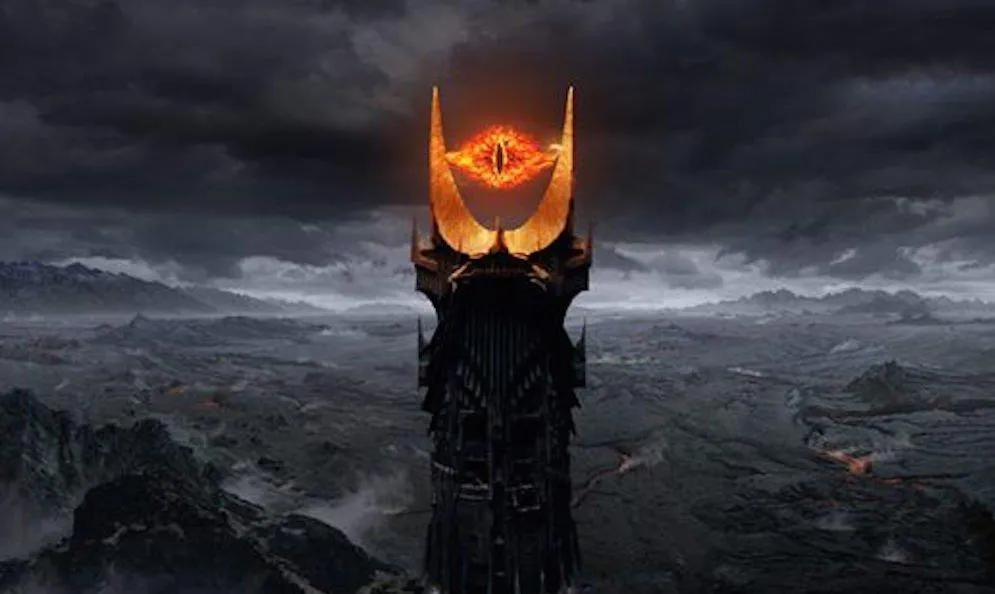
Again, this was just a niggle. The essay itself raises deep, serious, heartfelt questions about the nature of our societies and the Evil therein. The older I get, the more I appreciate Tolkein’s universe wherein he depicts reality in that fictional realm far better than just about any Western journalist paid to do so every day. It is reassuring to have his vision to inform us but a tad disturbing that the Truth and Values revealed therein are so generally absent in our culture today. Because we do live in a time when Evil is being given too much latitude; increasing totalitarian control is on the rise; the armies of Sauron are indeed already marching among us….
 baronbrasdor.art